La Tarcoteca

La Tarcoteca

lunes, 1 de mayo de 2017

Britannia Titanic – “UK Surveillance State More Suited to Dictatorship Than a Democracy”

Source - Britannia Titanic – “UK Surveillance State More Suited to Dictatorship Than a Democracy” | Global Research - Centre for Research on Globalization 27.4.2017

Until the revelations of Edward Snowden emerged just a few years back in 2013, British citizens had no idea as to the level of state surveillance they were subjected to. The government, without due process, debate or permission installed a massive taxpayer funded spying system via its domestic agency GCHQ, to tap into internet cables and build an enormous and detailed database of the communications of every man, woman and child in the country with little to no legal oversight. An ID system is no longer relevant, they have far more information than an ID card could ever store.

GCHQ’s 360 degree full spectrum bulk collection data system was constructed in brazen and arrogant defiance of Article 8 of the European Convention of Human Rights. Britain’s parliament never debated or approved this massive construction programme as it would for any national infrastructure project. Every phone call, no matter the device is recorded, every image, website visited, personal details such as medical and financial records, contacts, everything private to you is no longer private.
Under just one of dozens of surveillance programmes, one was called “Optic Nerve” that captured millions of images via webcams, illegally taken and stored. An undisclosed number, but estimated to be around one fifth of the population were images that were “compromising in nature” including that of naked young children in their homes and intimate images between consenting adults. The government were found to have acted illegally for 17 years. These were crimes and no-one was prosecuted. The standard response by government is the need for ‘national security’.
And let’s not forget, terrorism is fundamentally a politically generated problem. Britain has been complicit in the destruction of Afghanistan, Iraq, Libya and the ongoing crisis in Syria – all of which are in now in total chaos and all of which are the real breeding grounds for terrorism. No amount of internet surveillance on our own people will deal with that but the British people are now paying the price for that in more ways then one.
Although no-one truly knows the costs of UK state surveillance systems over its own population, it is estimated that the cost to the taxpayer just for the storage of all this data exceeds £20 million a month. And whilst GCHQ’s individual budget isn’t public knowledge, its funding comes from the Single Intelligence Account (SIA), which by all accounts has now reached something in the order (£18 billion as at 2015) £20 billion plus.
One can only guess that provision for GCHQ’s funding is exponentially increasing in an age of austerity where the NHS is in chaos, emergency services such as the fire-brigade and ambulance services to name just two are being stripped bare or privatised. People are dying at the hands of the state and yet we are told there is no money to pay for these vital services. And yet the taxpayer is still funding bank-bailouts, wars in far-off lands that pose zero threat to national security and a new architecture of state surveillance constructed that would make the East German Stasi blush three decades ago.
The government, both Labour and Tory, never had the intention of informing the country of the sheer scale of state surveillance, and it will continue to utilise illegal programmes irrespective of the law because it is only care of whistleblowers that we find out in the first place, now themselves the target of new legislation to silence them and the journalists who report these crimes.
Now we find, according to a report by civil liberties watchdog Big Brother Watch, that many secondary schools in England and Wales have installed  ‘Classroom Management Software’ not just in devices owned by the schools but by the pupils themselves.
Most English and Welsh secondary schools have installed software that apparently allows teachers to continually monitor their students’ internet activity. Most schools have failed in any way to inform the youngsters parents that they are being watched. No permission is asked of pupils.
In addition, through Freedom of Information requests the best guesstimate of the 8.2 million attending school was that 6 million were on a biometric database of some sort starting from the age of just four – and that was 10 years ago. By now one would expect that number to be close to 100% with facial recognition and other more recent technologies.
Why is Britain’s society under so much suspicion by its own government? The UK has one of the lowest homicide rates and ranked in the bottom quarter globally. The UK lies just inside the top third for terrorism deaths but still the number is exceedingly low. In fact, you are more likely to die by tripping over your underwear than die by the hand of a crazed terrorist. According the the annual Peace Index, Britain even ranks inside the top one third for its overall ‘peacefulness’. For all of this, Britain’s quite peaceful people are under permanent suspicion by its own government.
But Britain does excel in some crimes. Take for instance the banking industry. Some of the biggest frauds in history have been facilitated by Britain’s biggest banks. They have facilitated the world biggest money laundering activities of the worlds biggest narcotics dealers, human traffickers, modern slavery, arms dealers, despots and dictators – much of which has left hundreds of thousands dead in their countries embattled by such crimes. The state has not gone after these Armani suited mobsters working in glass towers and living in London’s penthouses.
Amnesty International and Saferworld, both members of the Control Arms coalition have rightly accused the UK Government for breaking national, EU and international laws and policy by supplying weapons to nations whose human rights abuses and war crimes are prolific and well documented. No arrests here either.
And here is some commentary of those attempting to keep your civil liberties and human rights in place whilst you watch these fundamental rights being salami sliced away by a paranoid state who surely have much to hide from you, the law-abiding taxpayer.
Renate Samson, the chief executive of Big Brother Watch, said:
“The passing of (investigatory powers bill) these laws has fundamentally changed the face of surveillance in this country. None of us online are now guaranteed the right to communicate privately and, most importantly, securely.”
Jim Killock, the executive director of Open Rights Group, said:
“The UK now has a surveillance law that is more suited to a dictatorship than a democracy. The state has unprecedented powers to monitor and analyse UK citizens’ communications regardless of whether we are suspected of any criminal activity.”
Rebecca Vincent, UK Bureau Director, Reporters Without Borders:
“Amber Rudd’s comments are yet another example of this government sacrificing freedom of expression, the right to privacy, and other human rights in the name of security, and contribute to a very worrying trend of increasing attacks on press freedom in the UK in recent months. The ability to communicate securely is essential for investigative journalists, their sources, and whistleblowers. Eliminating encryption tools would have a broad chilling effect, and would serve as another damaging blow to investigative journalism in the UK.“
Thomas Hughes, Executive Director, ARTICLE 19:
“Any discussions of a framework through which the security services can access our communications must be transparent. Knee-jerk political statements and rushed through deals are at best unhelpful at protecting our civil liberties and at worst a dangerous threat to them. The government risks eroding our freedoms at a time when it is alluding to a desire to protect them.”
David Anderson’s government-commissioned report in 2015 concluded that current surveillance legislation in the UK is “undemocratic, unnecessary, and—in the long run—intolerable,” and recommended that it be replaced with a new comprehensive law that is both transparent and proportionate, which did not happen. Indeed, in just two years Anderson’s worst fears have already materialised.
All of these civil liberty and human rights experts and activists know that this is not the way to manage a modern, progressive, outward looking nation fit for the 21st century – it’s a sinking ship full of paranoid salivating wolves looking to keep control of its unsuspecting flock.
Whilst reading this article it should have become apparent to you that YOU are under suspicion of being a criminal. And as it turns out you either are right now or will be. Don’t Pat your dog on the head. Don’t feed a homeless person a sandwich out of either sympathy or pity. Don’t feed a pigeon in the park. Don’t throw a busker a few pence and god-forbid that you should try and pull the wool over the eyes of the local authority to get your child into a better school, or decide to join a protest group like Greenpeace out of concern for the environment – then you would be in very serious trouble, because all of these ‘crimes’ are of ‘national security’ interest aren’t they! Ask yourself this question. Why exactly does my government treat me like this?
Look back into history and you might find some uncomfortable answers.

miércoles, 19 de abril de 2017

Trump’s Political Suicide Pushes China, Iran and Russia Closer

Source - Trump’s Political Suicide Pushes China, Iran and Russia Closer | Global Research - Centre for Research on Globalization 16.4.2016

The first aspect to consider, following the US attack on Syria, is what Putin, Xi, and Rohani, leaders of the Russian Federation, the People’s Republic of China, and Iran respectively, thought while American Tomahawks were hitting the Syrian air base of Shayrat.
The last three years of the Obama presidency highlighted two very different strategies being advanced simultaneously by the US and the nations opposing its imperialistic overreach, principally Russia, China and Iran. The latter have been seeking cooperation, while the US, with its big hammer, has characteristically been on the search for nails to hammer. Yet the management of international relations has always sought to maintain wide diplomatic channels, even putting in place precautions in the military arena, such as direct communication lines at the height of tensions of 2014 in Ukraine.
With the DPRK, Obama adopted an attitude of strategic patience rather than the posture being employed by Trump of military bullying. With Iran, Obama’s team negotiated a nuclear deal that included a lot of diplomacy between Moscow, Beijing and Washington. One could almost say that, with the exception of Ukraine and Syria, relations between Washington and major chancelleries in Eurasia had their ups and downs, but they rarely reached the levels of concern that were seen in the first days the Trump presidency.
Let us take Syria as an example. Obama resisted pressure to bomb the country following a false-flag chemical attack done by al Qaeda-type rebels. The media and intelligence accused Assad, but Obama saw through this and decided against further entanglement in the Syrian quagmire. Facing a similar situation, Trump instead decided to proceed and bomb a sovereign nation, creating a ripple effect whose ultimate results are at this stage difficult to discern.
Surely one of the first results has been the cancellation of any kind of cooperation between the US and Russia in Syria. This means that any nations operating against Islamist terrorism in Syria will be reluctant to grant further concessions to Washington. In recent weeks, Moscow and Damascus have preferred to hit Daesh and Nusra Front while inflicting relatively little damage to the Islamists in the country controlled by Washington and its allies, normally the FSA and its affiliates. This Russian posture was in deference to Kerry’s original request to Lavrov that a clear distinction be made between terrorists and so-called moderate rebels.
Moscow was aware from the beginning that there is no substantial differences between Nusra Front, Al-Qaeda, and other minor Daesh acronyms gathered around the FSA. All groups are armed and fighting against the legitimate Syrian government, making them legitimate targets, especially following America’s unilateral bombing of Syria.
The strategy of Damascus, Tehran and Moscow was aimed at finding a common understanding, from the diplomatic point of view, in order to bring Washington to the negotiating table. Concessions by both parties were necessary, and from the perspective of Russian forces, focusing on Nusra Front and Daesh was a good bargaining chip to use.
After Trump’s actions in Syria, all kinds of cooperation has been suspended, and it is anticipated that Damascus’s allies will specifically target US proxy forces in Syria as a response. The consequence will be that the US will have even less influence in Syria then before lobbing its 60-or-so missiles. In addition to this, Trump’s intention in the bombing should be seen as seeking to increase his negotiating position with Moscow on the question of Syria. What does not appear clear to the American president is that his actions may have the opposite effect. Putin is certainly not the type of person who lets others intimidate him or put him in a weak situation. If the intention of Trump was to create the ideal conditions for Tillerson and Lavrov to establish a cooperative relationship, perhaps it would be appropriate to ask what kind of understanding Trump has of international relations.
After this reckless action in Syria, Trump will have greater difficulty carrying out his plan to defeat Daesh, if this is still the plan. And so another election promise – the one to wipe Daesh off the map – is likely to be broken. This is not to mention that the SDF, the Kurdish forces, will from now on be viewed with more hostility by the Syrian and Russian forces, being ground troops who are undeclared by the US military.
Given the unpredictability of the US, Damascus cannot rule out the possibility that Washington’s final intent is to further the original plan of partitioning Syria as proposed by the Brookings Institute and embraced by the neocons and liberal-interventionist crowd. Moscow and Damascus cannot trust Washington, and this precludes many opportunities for Trump to pursue a foreign policy that aligns with his election promises.
President Xi during the Syrian bombing was at a diplomatic meeting with Trump and was told about the military action at the end of the meeting. It is likely that Trump wanted to send a message to the Chinese president and, indirectly, to Kim Jong-un, the leader of the DPRK. For the American president, this was all about a show of force, aimed at restoring the US role in the world and dictating the diplomatic conditions on which to agree for the resolution of various conflicts or areas of tension around the world. It is an approach that has almost entirely eliminated any possible cooperation with Beijing and Moscow.
Putin, Xi, and Rohani must leave behind any hopes for cooperation with Washington. It is important for them to send a strong message to Trump that the front opposing US imperialism is compact and ready to respond in the case of further provocations. Of course such a response need not necessarily be with military action but rather with all the alternatives available, such as with the areas of finance, the economy and diplomacy.
Until a few weeks ago, Moscow, Beijing and Tehran aimed at a resolution of problems with Washington in order to find a strategic balance in international relations. At this point in time, it should be clear that this strategy will not work. We are in a multipolar world that is synonymous with instability. The ideal conditions for a balance of political forces lie in a joint duopoly that recalls the situation that obtained during the Cold War. Even the unipolar moment guaranteed greater stability in a certain sense, given the unfortunate disproportion of force that the US enjoyed throughout the 1990s. What Trump finds hard to understand is that in a multipolar reality, the chances of clashes increase significantly.
Trump is meddling directly or indirectly in a lot of situations, ranging from Iran’s involvement in Syria, threatened by American partners such as Saudi Arabia; to the use of Russian forces in Syria; passing by the perennial crisis in Ukraine; and instability in the Caucasus and Central Asia. In China we have the autonomous region of Xinjiang, the South China Sea, and not to forget tensions with New Delhi as well as the explosive situation in the DPRK. If Trump is confident in being able to test the waters in each of these situations, even with the use of the military, to arrive at better negotiating positions, it is best that we all prepare for a nuclear winter.
The key issue for China, Russia and Iran must necessarily be to place emphasis on increasing cooperation in several areas, such as finance, the economy, the military, and politics. Up until a month ago, as a result of Trump’s victory over Hillary Clinton, all three of these nations aspired for cooperation in the field of international relations with the US on equal terms. After what happened in Syria, they have fully understood that this opportunity is now threatened by a clear desire by Trump to risk everything in order to improve his negotiating position. This is the reckless attitude of an unprepared POTUS.
Only a strong unity of purpose, under the economic umbrella of a jettisoning of the dollar as a reserve currency, can change the situation dramatically. In addition to this, the US dollar must be excluded in trade deals between cooperating nations. Another important effort lies with stocking up as much gold as possible. With these methods, it will be possible to stand up to the US’s pressure without it leading to a military conflict. Organizations such as the BRICS, SCO, Eurasian Union and One Belt, One Road must necessarily take up the challenge thrown down by Trump with the launch of 59 missiles on Syria, and show what consequences Trump has brought on himself through his rash actions. Moscow, Tehran and Beijing have an impetus to finally overcome any lingering hesitation and to completely disengage from the western system. Instead of creating alternative ways to operate in the economic and financial sphere, they should try to replace the current one, making it irrelevant and inconvenient for other nations.
The primary objective for these three nations must be from now on to resolve every dispute between them and form an alliance that goes beyond the mere question of economic or financial convenience. The goal should be to create a cultural and social system that can represent an opportunity for other third countries vis-a-vis a predatory capitalism and a rampant imperialistic approach that Trump appears to have signed onto.
Trump’s actions ultimately worsened the US State of the World. The failure of the military operation involving the launch of the Tomahawks showed the US to be more of a paper tiger today than the unbeatable war machine it depicts itself to be. Decades of corruption at the highest levels of the military-industrial complex have finally started to affect the United State’s ability to wage war. It is an observation that is a taboo amongst the US and its allies, who need to maintain the illusion for deterrence, as well as to allow for the gravy train to continue to line the pockets of those who profit from this corrupt system. Reality shows us that in any real conflict, the United States vulnerability and lack of combat readiness shows.
In a situation like this, the strategy of Moscow and its allies is to produce weapons systems capable of inflicting considerable damage to the United States at low cost, given that Moscow cannot simply print more money and pour debt on the rest of the world in order to finance its wars. A great example of this can be seen with the anti-ship missiles Moscow possesses, which are capable of destroying American aircraft carriers, considered the backbone of the US war strategy. A missile that costs hundreds of thousand of euros can cause damage to an aircraft carrier worth tens of billions of dollars, inflicting a mortal blow to the credibility of American military posture.
If Trump will continue down this destructive path, such as with encouraging the entrance of Montenegro into NATO after an election campaign where he labelled the Atlantic alliance obsolete, he will only get the opposite effect to the one desired, which is to say worse negotiating positions with peer American competitors like Moscow and Beijing. Maybe it is time to wonder whether Trump is really keen on a de-escalation model of international relations, aimed at brokering deals from positions of strength, or whether his ultimate aim is simply to preserve America’s unipolar moment in any possible way, even with war. It is a perspective that should be discussed widely by nations such as Iran, Russia and China in order to find a perfect asymmetrical response through economic, financial, political and social means that avoid a direct conflict. The war between the American elites seems to have come to an end and the neoliberals and neocons seem to have won. Wars and chaos will continue, as with the last decades of US foreign policy. It is a sad prospect that the nations opposing Washington will have to deal with.

viernes, 14 de abril de 2017

Open-air Genocide in China

Open-air Genocide in China | The Real Agenda News | The Real Agenda News

Industrial pollution from factories kills more than 100,000 people a year.
The convenience enjoyed by the western world comes at a heavy price. That price is high levels of environmental pollution that in China alone costs the lives of tens of thousands of people.
Both workers and people who live near industrial centres inevitably breathe heavily contaminated air around factories that manufacture  electronics later sold in Europe and the United States.
The huge air pollution generated by Chinese industry and displaced by the wind is associated with more than 3,100 premature deaths per year in Western Europe and the United States, according to a new international study.
The voracious consumption of Chinese products in the EU and the US is linked to almost 110,000 premature deaths each year in China due to air pollution caused by industrial production that follows very relaxed environmental standards.
Citizens of rich countries have cheap computers, mobiles and toys, and multinationals make more money, but in return hundreds of thousands of deaths take place in the Asian country.
The new study, led by economist Dabo Guan, is the first to estimate the transboundary health impacts of international trade and displaced air pollution.
The paper, which was published in the journal Nature, uses fine particulate pollution data (PM2.5) taken in 2007 around the world.
These particles, smaller than 2.5 thousands of a milimeter, penetrate deep into the lungs, the alveoli, and can reach the bloodstream, causing respiratory and cardiovascular diseases.
The authors link 22% of deaths – 762,400 – to the production of goods and services in one region to be consumed in another.
“Some regions consume while others produce and suffer the effects on health,” said a researcher at the University of East Anglia in Norwich, UK, at a press conference.
For every million consumers in Western Europe there are 416 deaths associated with PM2.5 contamination in other regions of the world, according to the study. The number of these deaths is reduced to 339 per million consumers in the United States.
The study involved about twenty scientists from leading institutions in China and the US, such as the California Institute of Technology or the Princeton and Beijing universities.
“If the price of imported products is low it is because in the production regions anti-pollution laws are less stringent, then consumer savings could be generated at the expense of lives lost in other regions,” the authors say unabashedly in The journal Nature.
Previous studies estimate that 90% of premature deaths due to air pollution are due to PM2.5 particles worldwide.
“Our study calculates to what extent air pollution is a global problem in a global economy,” said Qiang Zhang, a researcher specializing in atmospheric chemistry at Qinghua University in Beijing.
“Developed countries should encourage responsible consumption to mitigate negative effects on the environment and developing countries should improve the efficiency of their economies to reduce their local emissions, ” Zhang says.
Physicist Julio Díaz, author of numerous studies on pollution in Spain, applauds the new study, but warns of its “limitations of a global work”.
Guan’s research, according to Diaz, has not calculated the dose of pollution needed to cause health effects in each region, for example, depending on the different population pyramids.
Guan’s study extrapolates through previous studies. “It is an approximate computer model of emissions and burden of disease,” warns Diaz.
Anywhere else in the world, the annual death of 100,000 people due to air or water pollution would cause a major uproar among citizens, but no one in China nor abroad cares enough about the victims of environmental pollution in the Asian country.

miércoles, 8 de marzo de 2017

Announcing: The 2017 Earth First! Roadshow!

Announcing: The 2017 Earth First! Roadshow! - Earth First! Newswire 1.3.2017

Greetings all rabble rousers, water protectors, land defenders, anti-fascists, and resistance fighters.
In light of all the insanity that is our present political climate, a group of Earth First!ers are excited to announce the 2017 Earth First! Roadshow.
We’ll be hitting the road and planning a two month long cross-country roadshow that will end at the Round River Rendezvous in Northern California! We want to nurture the inspiring seeds of dissidence, learn about and support various cross-country struggles, and connect people and places to a political platform of “Fuck Trump and all the white supremacy, eco-terror, and rage he instills.”
Beginning in late April, we’ll be kicking off our tour in South Florida, and we aim to plan a route that coincides with several action camps and conferences throughout the country. Dates and places to be announced. Will you have us?
Small and rural towns will be given priority as we hash out dates and times. Get in touch with our collective to receive a list of skillshares/workshops we can offer in addition to a short presentation promoting biocentrism within a cross-struggle framework.
For all that is wild and toward a more free world,
Your friendly 2017 Earth First! Roadshow crew
For booking, questions, and comments, email us: earthfirstroadshow2017@riseup.net
earthfirstroadshow17.wordpress.com for tour updates

domingo, 5 de marzo de 2017

The insurrection of Ixmiquilpan – Ruptura Colectiva

Source - The insurrection of Ixmiquilpan – Ruptura Colectiva (RC) 5.7.2017

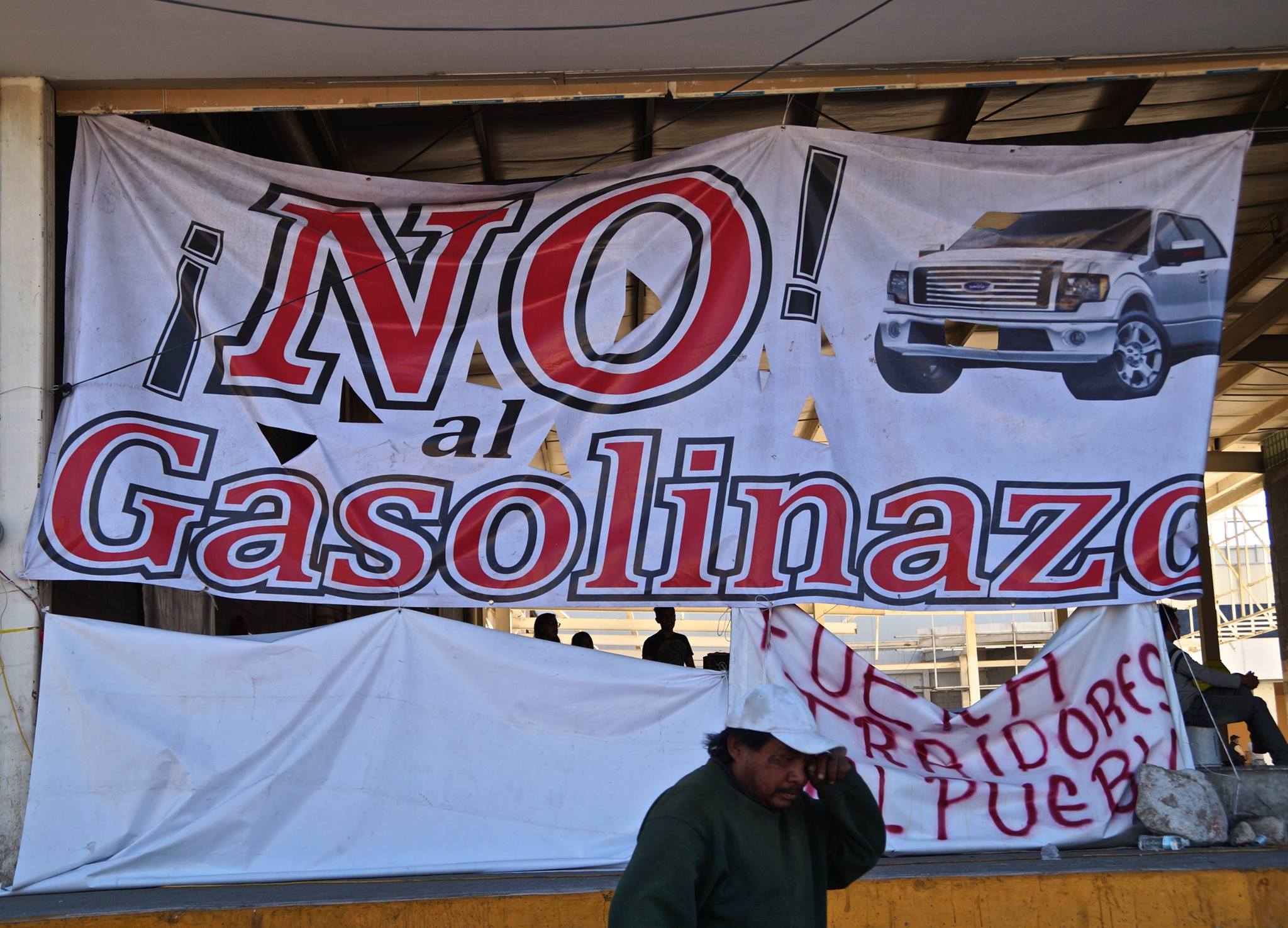
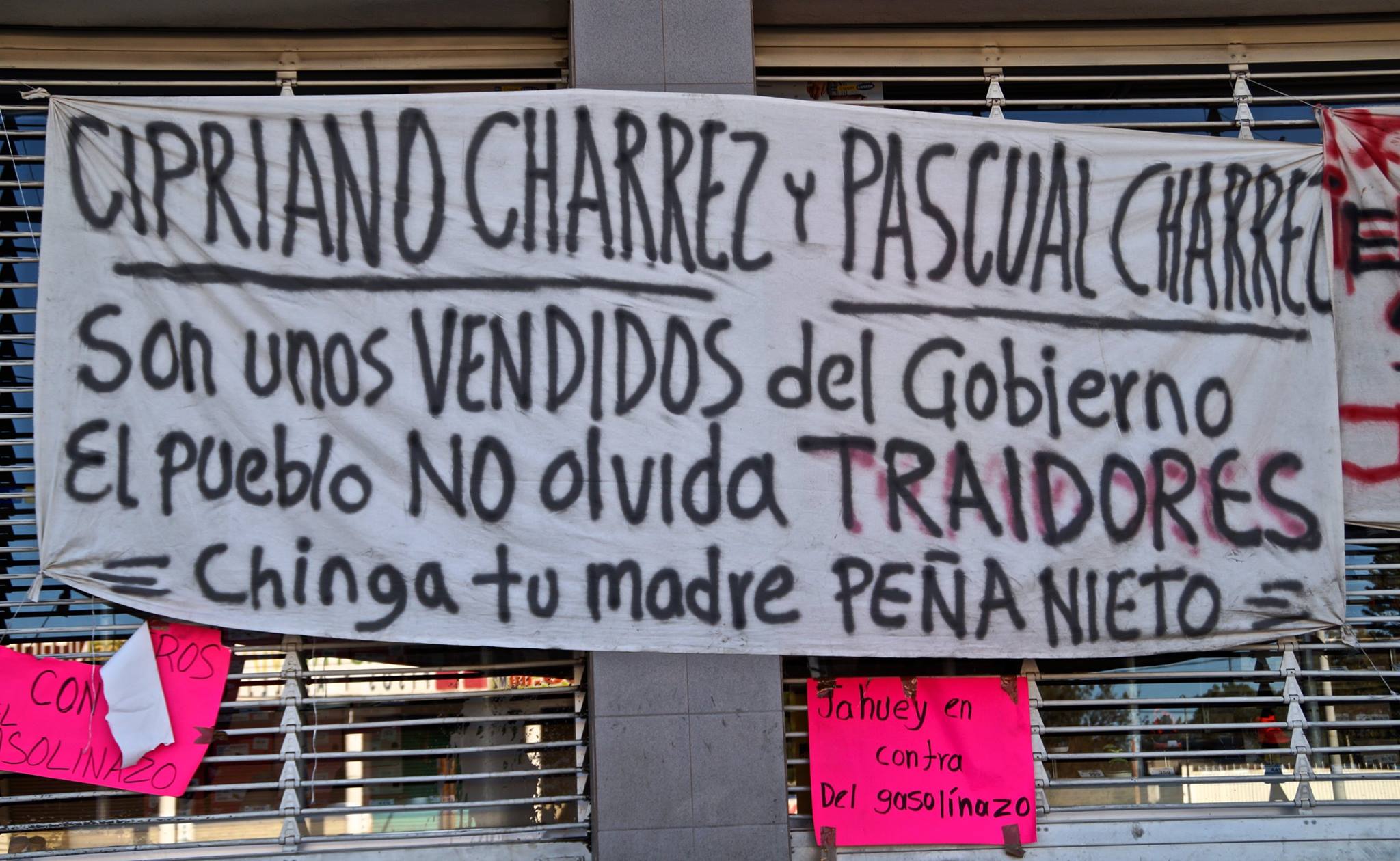
Hidalgo is a territory with past struggles, hidden in the pages of history and in the centralized understanding of social movements that don’t permit knowledge of what happens “over there in the province”. On January 5th, the people of Ixmiquilpan and other distant peoples of the Mezquital Valley would know what class war is. At the sound of the 2017 new years bells, various entities of the country were met with complete blockages of highways, Pemex facilities, gas stations and other strategic points in the context of the national #NoAlGasolinazo protests.
The closure of the Mexico-Laredo highway was one of the strongest, until it was met with an army (yes, it was an army trained to assassinate) of the state and federal police. This confrontation took place on January 5th in various points on both sides of the four-lane highway blockade, all with the intention to displace the people in resistance. At 2:30 pm, a gigantic trailer divided the contingents of the battle: on one side, an operation of more than 100 trucks and patrol cars with officers armed with firearms and tear gas; on the other, the people in resistance with sticks, rocks and firecrackers—tools that would served as instruments of war for the neighbors that took to the streets. The bells of Barrio de Jesús echoed for miles around.
The people won the first battle. It was evident that they would not lift the blockade. The forces stayed at the bonfires and barricades for long nights and were not willing to negotiate. Some state authorities offered to “form a commission to assist the House of Representatives and to thus avoid the violence,” but the people refused, rather reinforcing the barricades with sand bags.
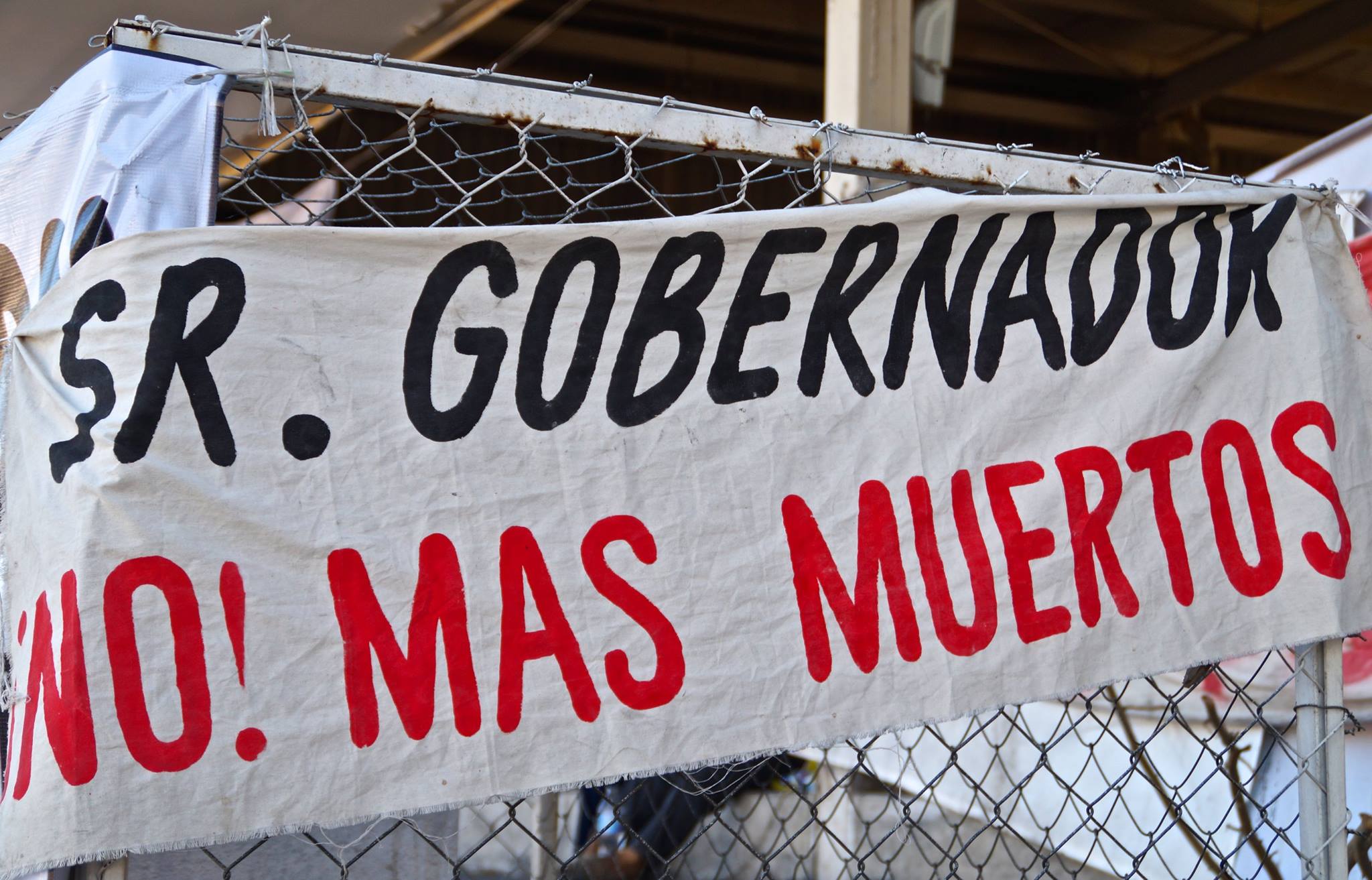
The police forces returned with more strength. Armored cars and bullets pushed the people of Ixmiquilpan back. On the sidewalk, two youth were caught in the heat of the battle: 22-year-old Alan Giovanni of the community Dios Padre and 25-year- old Fredy from the community of Maguey Blanco. They both lost their lives from bullet wounds. Thirteen others were injured.
I’ve said it before: death is imperative to the consciousness of social being. Voices and tears were more aware than ever and did not confuse words with actions: “This was violence from those of above, nearly a massacre!”
Although social-democrats and opportunists like Gerardo Fernández Noroña, John Ackerman and Javier Solalinde (El Padre Solalinse) have moved to preach peace in times of war and the importance of the electoral process, in the community assembly there are community members and affinity groups that are working hard to direct the struggle toward autonomy.   They are working toward the total self-management of life in the municipality, to rupture the dependence of people on political representatives. “Nobody will come and save us.”
There are some complaints against the mass media that talk of “chaos”, a “conflict” or a “final battle” in what clearly was the direct expression of class antagonism in an act of extermination against totally legitimate protest.
On January 19th, more than 2000 people marched in the city of Pachuca. They protested outside the congress to demand dialogue with the deputies that have approved the structural reforms: the media again, almost jokingly, said that the protestors “retained”, “cornered”, or “kidnapped” deputies. What side are the independent journalists on? They are small seeds that the people are planting, in order to move towards communicative autonomy, leaving paid and self-referenced cartoons to the “specialists of communication.”
After the insurrection, the organizational activities increased. On Sunday, January 15th, the state gathering “No to the gasolinazo” was celebrated with the participation of dozens of delegates from Hidalgo, teachers of the CNTE and people from other struggles in the country. On the 19th a march in Pachuca took place which culminated in the already mentioned “popular kidnapping” of deputies of the PRI. On Sunday the 22nd of January, workers from various multinational stores and institutions affected by the blockades, marched to demand that the “rioters open our centers of work”. For their part, the people of Ixmiquilpan gathered in the parking lot of the Comercial Mexicana to continue directing the routes of movement.
The stores remain closed until the workers have better salaries and that, in agreement with the managers and bosses, products of the campesinos of the municipality are bought and distributed in the stores. The banks only open every three days so that the people can collect or send money. The police aren’t welcome. The corollary is of vital importance: A popular consultation took place to remove the municipal president. Interesting things are being developed; the blood did not run in vain.
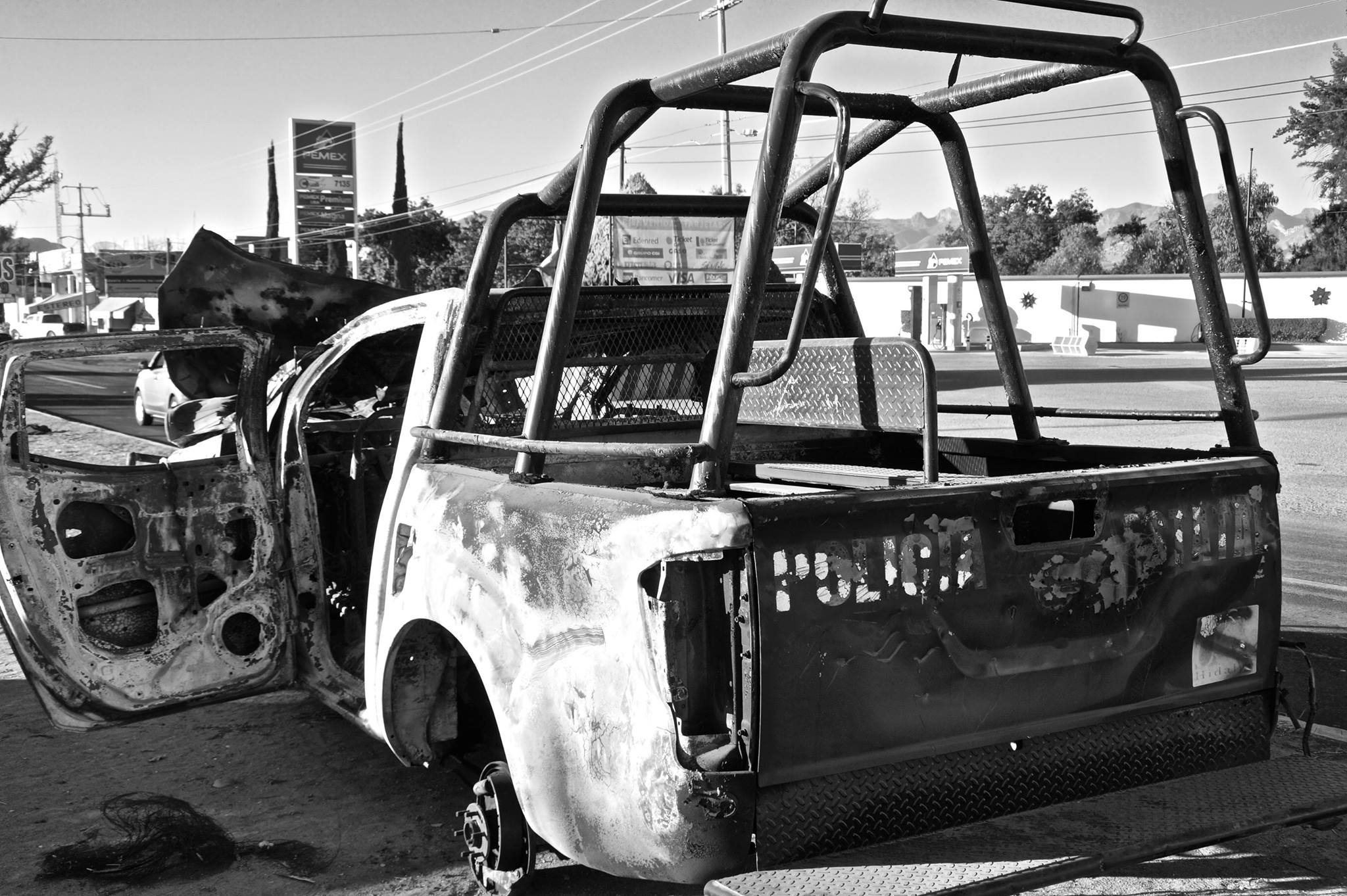
Today, the bone-metal remains of the arm of the state lie in the highway and the ghosts scream throughout the four lanes: we do not want any more dead!
Published on February 27, 2017 in:

martes, 28 de febrero de 2017

ANARCHISTS AND MARXISTS IN THE 21ST CENTURY (AN OPEN LETTER TO ANARCHISTS)

Source - Whatever-ism: Anarchists and Marxists in the 21st Century via Marxist World, sent by Mark O'Connor

This is an open letter addressed to anarchists, written by anarchist and Marxist World supporter Dennis Moore. Reproduced and slightly edited from the original blog post here.

Anarchism

Anarchism is a movement which seeks to overthrow the current social order in a revolution, establishing in its place a new society organised without hierarchy either in the form of exploitation, oppression or government.

Marxism
On the other hand, not many of us are completely clear on the answer to the question “what is Marxism?”. That’s probably partly because Marxists don’t even all agree on this (and not all of them have even read much Marx). Marxism is a number of things but for simplicity I’m going to boil it down to two:

1. Marxism is a method of social analysis:
Marxists view Marx’s contribution to the method of social analysis called ‘historical materialism’ as being on the level of what Issac Newton was to physics.

Newton’s analyses of physical phenomena were so accurate that he was able to make predictions about events (such as the movement of the planets) based on his theories which turned out to be reliably and repeatably correct – from an objective point of view (meaning they could be tested and observed by numerous people who would agree on what they saw). ‘Newtonian Physics’ eventually became established as the only serious method of doing physics and so the discipline could go back to just being ‘physics’ (obviously it’s also still being developed and perfected).

Marx’s work Das Kapital came to conclusions about how society works, proposing numerous ‘laws’ (like Newton’s laws of physics) about the rise of capitalism, the crises within capitalism and predicting the eventual fall of capitalism. He didn’t get this theory out of the blue, he build on the ideas of people who came before him and his own ideas have been further developed after him but to Marxists he is really the seminal thinker (hence the name of their movement!)

2. Marxism is a proposal for a new society:
The first part of Marxism involves no inherent claims to be ideological, even if it’s usually used by people who do have a particular clear ideology. It’s supposed to be a scientific, or at least a ‘scientific style’ of study, a discipline rather than an ethical position or a proposal for what should happen in the future.

Nevertheless Marx did leave some writings about what kind of society might exist after the revolution but even when he did so he wasn’t really starting from scratch thinking up the coolest idea he could come up with for how everyone should live.

Marx suggested that the ideas and methods and even the core of the structure of the future society has to come out of the old, and also that the forces that will create it have to come from within the old society too. He sums it up in this beautiful passage:

<<Along with the constantly diminishing number of the magnates of capital, who usurp and monopolise all advantages of this process of transformation, grows the mass of misery, oppression, slavery, degradation, exploitation; but with this too grows the revolt of the working class, a class always increasing in numbers, and disciplined, united, organised by the very mechanism of the process of capitalist production itself. The monopoly of capital becomes a fetter upon the mode of production, which has sprung up and flourished along with, and under it. Centralisation of the means of production and socialisation of labour at last reach a point where they become incompatible with their capitalist integument. This integument is burst asunder. The knell of capitalist private property sounds. The expropriators are expropriated. (Marx, Capital, 1867)

Marxism and Anarchism

Much of the discussion of Marxism and anarchism focuses on the original split or on how anarchists have been betrayed or persecuted by various ‘Marxist’ regimes. There is another side to the story.

Many Marxists were utterly opposed to Stalin and went into the gulags alongside the anarchists because of it (and many Marxist thinkers and activists today recognise that this would have been their fate too in that context). Marxists fought against the fascists in Spain alongside anarchists in open defiance of Stalin and repeatedly showed solidarity in anti-fascist struggles ever since. It was Marxists who were predominately involved in the Zapatista uprising in the beginning. Then we have Marxists like Henri Lefebvre who took up Marx’s tools and used them more holistically than they had been previously, or hero’s like Rosa Luxemburg who we all know and love who died for the cause.

There is also the fact that many anarchists travelled to Russia in the early days of the Soviet Union hoping to participate in the revolution, inspired by pamphlets such as Lenin’s ‘State and Revolution’ which planned for the withering away of the state to start immediately and any semi-state/ commune type arrangement to be solely used for defending the revolution not for ruling the newly liberated masses.

And this isn’t necessarily just fringe ‘council communists’ or those who specifically name themselves ‘libertarian Marxists’. Today those who call themselves ‘orthodox Marxists’ are just as likely to see the left-wing of Marxism throughout the 20th century as those who held true to the movement against the perversions of Stalin and co.

Another factor in all this is that we’ve got to live in the present. The USSR is gone. Endless debate over who did what to who and when exactly it went wrong (1918, 1924, 1956 or for the hardcore 1991) is potentially dangerous. The conditions that caused Lenin to make the decisions that he did are gone, the conditions that brought about the rise of Stalin are gone, the conditions that caused anarchism to go off into the wilderness after WW2 are gone… we live now.

All this has led me to the conclusion that the best of Marxism and the best of Anarchism are stood right next to each other and the worst of both are equally crap.

Let’s review some of the crap so we can be clear about who drags both of our movements down. That way the serious revolutionaries who are left should feel released from the burden of constantly feeling the need to apologise for their embarrassing hangers on:

Lifestylism
Some anarchists seem to think that dressing up in black bloc, eating out of bins and listening to punk music all feels very revolutionary and if it feels revolutionary and looks/ sounds a bit revolutionary then it must really be revolutionary (not that there is any problem with doing these things or with any kind of non-oppressive lifestyle, it’s just that it’s a lifestyle, not a revolutionary movement).

These, the people who think that the anarchist aesthetic is the movement, are the people who turn up to an action and they’re already high, that expect the right to do whatever they feel like with no accountability to the movement because they “believe in freedom” and “only answer to themselves”. Unfortunately it doesn’t work like that. We can’t conjure up revolution through rituals as social anarchist Murray Bookchin pointed out:

<<What is most troubling is that the self-indulgent aesthetic vagaries of lifestyle anarchism significantly erode the socialist core of a left-libertarian ideology that once could claim social relevance and weight precisely for its uncompromising commitment to emancipation — not outside of history, in the realm of the subjective, but within history, in the realm of the objective. (Bookchin, Social Anarchism or Lifestyle Anarchism: An Unbridgeable Chasm, 1995)

Lifestylism can also sneak into the Marxist movement too: Regimented marching, the hammer and sickle flag (ripped from it’s original context) – [we’ll get to the big Stalin banner next]… We don’t get an inch closer to communism just by adopting it’s apparent trappings.

Stalinism
Stalinism should be irrelevant. Stalin has been dead for 64 years and the Soviet Union has been history for 26 years. There is no Stalin to be a supporter of. It now seems to manifest itself as a slavish devotion on the fringes of the Marxist movement to any “communist” regime no matter how completely they’ve completely degenerated/morphed into something else.

These are the people who are still desperately trying to whip up support for the Chinese state on the basis of anti-imperialism no matter how internally repressive the Chinese government acts, no matter how many Chinese billionaires there are with close ties to the state and how ruthlessly they exploit the Chinese working class… they even support China in the face of it’s own imperialism and domination of it’s near neighbours. Stalinism is firmly crap.

Class CollaborationOne that some anarchists get a bit tempted by; the idea of anarchism as just a really good philosophy or even just a moral code for the whole world to follow. These are the people who seek out seemingly enlightened or progressive elements of the ruling class and try to influence them with anarchist ideals.

Waste of time. You’ll either have the dogs set on you or you’ll end up being adopted as a pet radical to parade around. The ruling class have no interest in changing the system that gives them all the power and wealth they currently enjoy.

Kropotkin ended up falling into this trap, being a favourite guest at progressive dinner parties later in life, however it was already partly visible in ‘Conquest of Bread’ too. He writes of his bedazzlement at the capitalist railway companies co-operating to cover Europe in a rail network as proof that humans don’t need government to make them co-operate:

<<If a man had foreseen or predicted it fifty years ago, our grandfathers would have thought him idiotic or mad. They would have said: “Never will you be able to make the shareholders of a hundred companies listen to reason ! It is a Utopia, a fairy tale. A central Government, with an ‘iron’ director, can alone enforce it.” (Kropotkin, Conquest of Bread, 1892)

It should be fairly obvious what’s wrong with that example…

Reformism
Maybe it’s because they don’t usually eat out of bins, maybe it’s because they’ve read so many fancy books but for one reason or another some Marxists end up wanting to be ‘legitimised’. To seek legitimacy means that in return for no longer being arrested, sacked from their jobs, slandered in the press or spied on, they drop their talk about revolution and limit their ambitions to reforms within capitalism. They then take their place helping to manage the rowdiest elements of the working class and ensuring they don’t step over the mark and ruin the legitimacy that has been achieved. The rest of the Marxist movement doesn’t welcome this kind of behaviour.

Sectarianism
Both Marxists and anarchists seem to be equally at risk of bitter sectarianism. Sectarianism might be something that can be indulged in when the struggle goes quiet and there is little opportunity and little at stake. Anyone failing to read even the most basics signs of the times right now and falling into unnecessary squabbles while the world burns around them is a distraction and a hindrance to our progress. Sectarianism is much more than being clear and resolute about your views it’s prime manifestation is those people whose allegiance is not to the working class but to their particular organisation or even just their favourite set of ideas.

Left Unity?
zabalaza.net
Anarchists have also already got a long tradition of using Marxist tools for analysis or even relying on the analysis that Marxists have already done to see where there is scope for the class struggle to improve and expand and for general education.

Many Marxists also recognise and respect the anarchist movement where it is strongest for bringing out some of the most militant and active sections of the working class and getting shit done.

Marxists may be surprised to learn than most anarchists are serious about class struggle and are actually fairly well read. Anarchists may be surprised to learn than most Marxists are serious about smashing the state and are resolutely anti-oppression too, not just anti-exploitation.

But where do we go from here, an alliance? A truce? A synthesis? No. All of those are either weak or horrible ideas. Left unity is based on the mistaken notion that it’s people with similar ideas or beliefs that have interests in common and cause to unite. The remedy is class unity.

Class unity doesn’t demand that anyone ‘put their differences aside’ it demands instead that we act in the already shared interests of the working class. Unity arises from our shared class position and it takes it’s primary form in joint action, not joint dogma.

And yet none of this is to write ideas, dreams, goals, beliefs or ethical codes off as being nothing. Obviously none of us would bother if we didn’t have ideals. We can learn from each other and will benefit from doing so. It’s also not to say that anyone should give up on calling themselves an anarchist or try to deny what they love about the anarchist ideal.

Learning from Marxism
It’s my opinion that anarchists would benefit hugely from reading both ‘Capital’ by Marx and ‘State and Revolution’ by Lenin and really getting to grips with them (you probably won’t have read anything like them). This would unite us around a basic understanding, clear up some of the muddled thinking we have in our midst and give us a general direction to head in and some expectations of what is likely to happen at each stage.

We need to learn that describing the perfect society, even if we stay up all night and read ‘Conquest of Bread’ twice over, isn’t going to make it real. Getting there is all important. This doesn’t have to make us boring ‘realists’ in the sense that we should limit our ambitions, it’s just that they need to become more than just ambitions.

So how might we make it all real?

A simplified Marxist programme:

1: Revolution (smashing the state, expropriating the capitalists)

<<According to Engels, the bourgeois state does not “wither away”, but is “abolished” by the proletariat in the course of the revolution. What withers away after this revolution is the proletarian state or semi-state. (Lenin, State and Revolution, 1917)

From the Paris Commune onward Marx became convinced that the working class had no use for the capitalists’ state machinery. What to replace it with (and what to call it’s replacement), is stage 2:

2: Replace it with a commune type arrangement to protect the gains of the revolution

<<As the state is only a transitional institution which is used in the struggle, in the revolution, to hold down one’s adversaries by force, it is sheer nonsense to talk of a ‘free people’s state’; so long as the proletariat still needs the state, it does not need it in the interests of freedom but in order to hold down its adversaries, and as soon as it becomes possible to speak of freedom the state as such ceases to exist. We would therefore propose replacing the state everywhere by Gemeinwesen, a good old German word which can very well take the place of the French word commune.

And:

<<The free people’s state has been transferred into the free state. Taken in its grammatical sense, a free state is one where the state is free in relation to its citizens, hence a state with a despotic government. The whole talk about the state should be dropped, especially since the Commune, which was no longer a state in the proper sense of the word. The ‘people’s state’ has been thrown in our faces by the anarchists to the point of disgust…

Both of the above are quotes from a letter sent from Engels to August Babel (leader of the German workers’ party) in 1875.

<<So long as the state exists there is no freedom. When there is freedom, there will be no state. (Lenin, State and Revolution, 1917)

Marxists talk about the use of a state as a transitional stage. As can be seen from the quotations above they’re not really talking about a state. They are talking about the need to maintain some level of organisation after the revolution in order to protect what has been gained. Not an organisation to re-establish rule over the newly liberated working class.

3: Dismantle even this level of political organisation

Finally develop society freely and directly democratically, (having now completely suppressed any attempt at counter revolution) towards a post-scarcity and what we call anarchy/ anarchist communism/ luxury communism or what they (Marxists) just call communism (we won’t care by that point, we’ll just get the robots to make us another drink while we chill on the veranda).

Conclusions
Could anarchists and Marxists unite around this? I think they probably could. Is any of it really a deal breaker for anarchists? Probably not for most.

Obviously anarchists will want to have an influence and ensure that each stage is as libertarian as possible and Marxists should respect that many workers are attracted to anarchism and anarchist-type ideas precisely because they are suspicious of authority and having decisions made for them. At this point anarchism and Marxism could become tendencies within a revolutionary workers movement instead of separate competing ideologies.

The past is the past. Many of the disputes are exaggerated, distorted or the product of conditions or even specific personalities that are long gone.

This generation has to forge something new to deal with the challenges of what seems like it could be capitalism’s final decades. Many of us will probably live long enough to see either collapse into war, famine and environmental destruction or revolution.