This September 15th marks the 150th anniversary of the St. Imier Congress in Switzerland, when delegates representing sections of the International Workingmen’s Association reconstituted the International along anti-authoritarian lines, following the expulsion of Michael Bakunin and James Guillaume from the International at the behest of Marx and Engels at the Hague Congress on September 7, 1872. I prepared the following article on the St. Imier Congress and its aftermath for Black Flag Anarchist Review’s Summer 2022 issue on anarchism and the First International. The special conference to celebrate the 150th anniversary of the St. Imier Congress has been postponed to July 2023:www.Anarchy2023.org.Saint Imier
The St. Imier Congress and the Birth of Revolutionary Anarchism
The September 1872 St. Imier Congress of federalist and anti-authoritarian sections and federations of the International Workingmen’s Association (the “IWMA”), otherwise known as the “First International,” marks a watershed moment in the history of socialism and anarchism.
Just over a week earlier, at the Hague Congress of the International (September 2 – 7, 1872), Karl Marx and Friedrich Engels had engineered the expulsion of Michael Bakunin and James Guillaume from the International on trumped up grounds, and then had the General Council of the International transferred from London to New York, despite the General Council having been granted increased powers to ensure ideological uniformity. The Hague Congress had also passed a resolution mandating the formation of national political parties for the purpose of achieving political power.
While Marx and Engels’ allies at the Hague Congress, notably the French Blanquists (followers of Auguste Blanqui, a radical French socialist who advocated revolutionary dictatorship), had supported the expulsions of Bakunin and Guillaume, they were taken by surprise when Marx and Engels succeeded in transferring the executive power of the International, the General Council, to New York, and had quit the International in disgust. The New York based “International” quickly became an irrelevant rump.
Much to the surprise and consternation of Marx and Engels, far from neutralizing the federalist and anarchist elements of the International through the expulsion of Bakunin and Guillaume and the transfer of the General Council to New York, these actions helped solidify support for a reconstituted International that embraced federalist principles and rejected centralized power.
A majority of the International’s sections and federations did not support the resolutions of the Hague Congress. Barely a week after the Hague Congress, several of them held their own congress in St. Imier, Switzerland, where they reconstituted the International independent of the shell organization now controlled by Marx and Engels through the General Council.
The opponents of the Marxist controlled International were united in their opposition to the concentration of power in the General Council, regardless of whether the Council sat in London or New York. They also shared a commitment to directly democratic federalist forms of organization. Some were completely opposed to the formation of working class political parties to achieve state power, while others were opposed to making that a mandatory policy regardless of the views of the membership and local circumstances. The reconstituted anti-authoritarian wing of the International was to have anarchist, syndicalist and, for a time, reformist elements.
The St. Imier Congress began on September 15, 1872, just eight days after the Hague Congress. It was attended by delegates from Spain, France, Italy and Switzerland, including Guillaume and Adhémar Schwitzguébel from Switzerland; Carlo Cafiero, Errico Malatesta, Giuseppi Fanelli, and Andrea Costa from Italy; Rafael Farga-Pellicer and Tomás González Morago from Spain; and the French refugees, Charles Alerini, Gustave Lefrançais, and Jean-Louis Pindy. Bakunin, although living in Switzerland, attended as an Italian delegate.
A “regional” congress of the Swiss Jura Federation was held in conjunction with the “international” congress, with many of the same delegates, plus members of the Slav Section, such as Zamfir Arbore (who went under the name of Zemphiry Ralli) and other French speaking delegates, including Charles Beslay, an old friend of Proudhon’s who went into exile in Switzerland after the brutal suppression of the Paris Commune in 1871.
Virtually all of the participants were either anarchists or revolutionary socialist federalists, and many of them went on to play important roles in the development of anarchist and revolutionary socialist movements in Europe.
The assembled delegates adopted a federalist structure for a reconstituted International (or the “anti-authoritarian International”), with full autonomy for the sections, declaring that “nobody has the right to deprive autonomous federations and sections of their incontrovertible right to decide for themselves and to follow whatever line of political conduct they deem best.” For them, “the aspirations of the proletariat can have no purpose other than the establishment of an absolutely free economic organization and federation, founded upon the labour and equality of all and absolutely independent of all political government.” Consequently, turning the Hague Congress resolution regarding the formation of political parties for the purpose of achieving political power on its head, they proclaimed that “the destruction of all political power is the first duty of the proletariat.”
With respect to organized resistance to capitalism, the delegates to the St. Imier Congress affirmed their position that the organization of labour, through trade unions and other working class forms of organization, “integrates the proletariat into a community of interests, trains it in collective living and prepares it for the supreme struggle,” through which “the privilege and authority” maintained and represented by the State will be replaced by “the free and spontaneous organization of labour.”
While the anti-authoritarian Internationalists entertained no illusions regarding the efficacy of strikes in ameliorating the condition of the workers, they regarded “the strike as a precious weapon in the struggle.” They embraced strikes “as a product of the antagonism between labour and capital, the necessary consequence of which is to make workers more and more alive to the gulf that exists between the bourgeoisie and the proletariat,” bolstering their organizations and preparing them “for the great and final revolutionary contest which, destroying all privilege and all class difference, will bestow upon the worker a right to the enjoyment of the gross product of his labours.”
Here we have the subsequent program of anarcho-syndicalism: the organization of workers into trade unions and similar bodies, based on class struggle, through which the workers will become conscious of their class power, ultimately resulting in the destruction of capitalism and the state, to be replaced by the free federation of the workers based on the organizations they created themselves during their struggle for liberation.
The resolutions from the St. Imier Congress received statements of support from the Italian, Spanish, Jura, Belgian and some of the English speaking American federations of the International, with most of the French sections also approving them. In Holland, three out of the four Dutch branches sided with the Jura Federation and the St. Imier Congress. The English Federation, resentful of Marx’s attempts to keep it under his control, rejected “the decisions of the Hague Congress and the so-called General Council of New York.” While the longtime English member of the International, John Hales, did not support revolution, he advised the Jura Federation that he agreed with them on “the principle of Federalism.” At a congress of the Belgian Federation in December 1872, the delegates there also repudiated the Hague Congress and the General Council, supporting instead the “defenders of pure revolutionary ideas, Anarchists, enemies of all authoritarian centralisation and indomitable partisans of autonomy.”
However, there was a tension in the resolutions adopted at the St. Imier Congress. On the one hand, one resolution asserted the “incontrovertible right” of the International’s autonomous federations and sections “to decide for themselves and to follow whatever line of political conduct they deem best.” On the other hand, another resolution asserted that “the destruction of all political power is the first duty of the proletariat.”
The resolution regarding the autonomy of the federations and sections in all matters, including political action, was meant to maintain the International as a pluralist federation where each member group was free to follow their own political approach, so that both advocates of participation in electoral activity and proponents of revolutionary change could co-exist.
However, the call for the destruction of all political power expressed an anarchist position. The two resolutions could only be reconciled if the destruction of political power was not necessarily the “first duty of the proletariat,” but could also be regarded as a more distant goal to be achieved gradually, along with “the free and spontaneous organization of labour.”
The tension between these two resolutions continued to exist within the reconstituted International for several years. James Guillaume supported political pluralism within the International and sought to convince some of the sections and federations that had gone along with Marx, such as the Social Democrats in Germany, to rejoin the anti-authoritarian International, and to keep the English Internationalists who had rejected Marx’s centralist approach, such as Hales, within the reconstituted International.
Although the German Social Democrats never officially joined the reconstituted International, two German delegates attended the 1874 Brussels Congress. English delegates attended both the September 1873 Geneva Congress and the September 1874 Brussels Congress, where there was an important debate regarding political strategy, including whether there was any positive role for the state.
The Geneva Congress in September 1873 was the first full congress of the reconstituted International. It was attended by delegates from England, France, Spain, Italy, Holland, Belgium and Switzerland. The English delegates, John Hales and Johann Georg Eccarius (Marx’s former lieutenant), had been members of the original International. They were interested in reviving the International as an association of workers’ organizations, and in disavowing the Marxist controlled General Council and International that had been transferred by Marx and Engels to New York. They had not become anarchists, as Hales made clear by declaring anarchism “tantamount to individualism… the foundation of the extant form of society, the form we desire to overthrow.” Accordingly, from his perspective, anarchism was “incompatible with collectivism” (a term which at the time was synonymous with socialism).
The Spanish delegate, José Garcia Viñas, responded that anarchy did not mean disorder, as the bourgeois claimed, but the negation of political authority and the organization of a new economic order. Paul Brousse, a French refugee who had recently joined the Jura Federation in Switzerland, agreed, arguing that anarchy meant the abolition of the governmental regime and its replacement by a collectivist economic organization based on contracts between the communes, the workers and the collective organizations of the workers, a position that can be traced back to Proudhon.
Most of the delegates to the Congress were anti-authoritarian federalists, and the majority of them were clearly anarchist in orientation, including “Farga-Pellicer from Spain, Pindy and Brousse from France, Costa from Italy, and Guillaume and Schwitzguebel from Switzerland.” Also within the anarchist camp were Garcia Viñas from Spain, who was close to Brousse, Charles Alerini, a French refugee now based in Barcelona associated with Bakunin, Nicholas Zhukovsky, the Russian expatriate who remained close to Bakunin, François Dumartheray (1842-1931), another French refugee who had joined the Jura Federation, Jules Montels (1843-1916), a former provincial delegate of the Commune who was responsible for distributing propaganda in France on behalf of the exiled group, the Section of Revolutionary Socialist Propaganda and Action, and two of the Belgian delegates, Laurent Verrycken and Victor Dave.
The American Federal Council sent a report to the Congress, in which it indicated its support for the anti-authoritarian International. The Americans were in favour of freedom of initiative for the members, sections, branches and federations of the International, and agreed with limiting any general council to purely administrative functions. They felt that it should be up to each group to determine their own tactics and strategies for revolutionary transformation. They concluded their address with “Long live the social revolution! Long live the International.”
At the 1873 Geneva Congress, it was ultimately agreed to adopt a form of organization based on that followed by the Jura Federation, with a federal bureau to be established that “would be concerned only with collecting statistics and maintaining international correspondence.” As a further safeguard against the federal bureau coming to exercise authority over the various sections and branches, it was to “be shifted each year to the country where the next International Congress would be held.”
The delegates continued the practice of voting in accordance with the mandates that had been given to them by their respective federations. Because the International was now a federation of autonomous groups, each national federation was given one vote and the statutes were amended to explicitly provide that questions of principle could not be decided by a vote. It was up to each federation to determine its own policies and to implement those decisions of the congress that it accepted.
Eccarius also attended the next Congress in Brussels in September 1874 as the English delegate. He and the two German delegates remained in favour of a workers’ state and participation in conventional politics, such as parliamentary elections.
The most significant debate at the Brussels Congress was the one over public services. César De Paepe, on behalf of the Belgians, argued that if public services were turned over to the workers’ associations, or “companies,” the people would simply “have the grim pleasure of substituting a worker aristocracy for a bourgeois aristocracy” since the worker companies, “enjoying a natural or artificial monopoly… would dominate the whole economy.” Neither could all public services be undertaken by local communes, since “the most important of them,” such as railways, highways, river and water management, and communications, “are by their very nature fated to operate over a territory larger than that of the Commune.” Such intercommunal public services would therefore have to be run by delegates appointed by the federated communes. De Paepe claimed that the “regional or national Federation of communes” would constitute a “non-authoritarian State… charged with educating the young and centralizing the great joint undertakings.”
However, De Paepe took his argument one step further, suggesting that “the reconstitution of society upon the foundation of the industrial group, the organization of the state from below upwards, instead of being the starting point and the signal of the revolution, might not prove to be its more or less remote result… We are led to enquire whether, before the groupings of the workers by industry is sufficiently advanced, circumstances may not compel the proletariat of the large towns to establish a collective dictatorship over the rest of the population, and this for a sufficiently long period to sweep away whatever obstacles there may be to the emancipation of the working class. Should this happen, it seems obvious that one of the first things which such a collective dictatorship would have to do would be to lay hands on all the public services.”
De Paepe’s position was opposed by several delegates, including at least one of the Belgians, Laurent Verrycken. He spoke against any workers’ state, arguing that public services should be organized by “the free Commune and the free Federation of communes,” with the execution of the services being undertaken by the workers who provided them under the supervision of the general association of workers within the Commune, and by the Communes in a regional federation of Communes. Farga Pellicer (“Gomez”), on behalf of the Spanish Federation, said that “for a long time they had generally pronounced themselves in favour of anarchy, such that they would be opposed to any reorganization of public services that would lead to the reconstitution of the state.” For him, a “federation of communes” should not be referred to as a “state,” because the latter word represented “the political idea, authoritarian and governmental,” as De Paepe’s comments regarding the need for a “collective dictatorship” revealed.
The most vocal opponent of De Paepe’s proposal was Schwitzguébel from the Jura Federation. He argued that the social revolution would be accomplished by the workers themselves “assuming direct control of the instruments of labor;” thus, “right from the first acts of the Revolution, the practical assertion of the principle of autonomy and federation… becomes the basis of all social combination,” with “all State institutions,” the means by “which the bourgeoisie sustains its privileges,” foundering in the “revolutionary storm.” With “the various trades bodies” being “masters of the situation,” having “banded together freely for revolutionary action, the workers will stick to such free association when it comes to organization of production, exchange, commerce, training and education, health, and security.”
On the issue of political action, the Belgian delegates to the Brussels Congress continued to advocate working outside of the existing political system, albeit partly because they did not yet have universal suffrage in Belgium. Nevertheless, they claimed they did not expect anything from the suffrage or from parliament, and that they would continue to organize the workers into the trades bodies and federations through which the working class would bring about the social revolution, revealing that, as a group, the Belgian Federation did not yet share De Paepe’s doubts that the free federation of the producers would not be the means, but only the result, of a revolution.
The French delegate indicated that the French Internationalists remained anti-political, seeking to unite the workers “through incessant propaganda,” not to conquer power, but “to achieve the negation of all political government,” organizing themselves for “the true social revolution.”
The Congress ultimately declared that it was up to each federation and each democratic socialist party to determine for themselves what kind of political approach they should follow. Nevertheless, it is fair to say that as of September 1874, the majority of the anti-authoritarian International continued to embrace an anarchist or revolutionary syndicalist position. At the end of the 1874 Brussels Congress, the delegates issued a manifesto confirming their commitment to collectivism, workers’ autonomy, federalism and social revolution; in a word, nothing less than the original goal of the International itself: “the emancipation of the workers by the workers themselves.”
By the time of the October 1876 Bern Congress, the English had ceased participating in the anti-authoritarian International. The debate over the “public service” state continued, with De Paepe now openly advocating that the workers “seize and use the powers of the State” in order to create a socialist society. Most of the delegates rejected De Paepe’s position, including Guillaume and Malatesta.
Malatesta argued for “the complete abolition of the state in all its possible manifestations.” While Guillaume and some of the other veteran anti-authoritarians liked to avoid the “anarchist” label, Malatesta declared that “Anarchy, the struggle against all authority … always remains the banner around which the whole of revolutionary Italy rallies.” Both Malatesta and Guillaume made clear that in rejecting the state, even in a “transitional” role, they were not advocating the abolition of public services, as De Paepe implied, but their reorganization by the workers themselves.
In September 1877, the anti-authoritarian International held a congress in Verviers, Belgium, which was to be its last. Guillaume and Peter Kropotkin, now a member of the Jura Federation, attended from Switzerland. The French refugees, Paul Brousse and Jules Montels, also attended. In addition, there were Garcia Viñas and Morago from Spain. Otto Rinke and Emil Werner, both anarchists, “represented sections in both Switzerland and Germany, while there was a strong delegation from the Verviers region, the last stronghold of anarchism in Belgium.” Costa represented Greek and Egyptian socialists who were unable to attend, as well as the Italian Federation.
De Paepe did not attend the Congress, as he was preparing for his rapprochement with social democracy and parliamentary politics at the World Socialist Congress that was about to begin in Ghent. In anticipation of the Ghent Congress, the delegates to the Verviers Congress passed several resolutions emphasizing the limited bases for cooperation between the now predominantly anarchist oriented anti-authoritarian International and the social democrats. For the Verviers delegates, collective property, which they defined as “the taking of possession of social capital by the workers’ groups” rather than by the State, was an immediate necessity, not a “far-off ideal.”
On the issue of political action, the delegates indicated that class antagonism could not be resolved by government or some other political power, but only “by the unified efforts of all the exploited against their exploiters.” They vowed to combat all political parties, regardless of “whether or not they call themselves socialists,” because they did not see electoral activity as leading to the abolition of capitalism and the state. While the majority of the delegates therefore supported anti-parliamentary socialism, none of the policies endorsed at the congresses of the reconstituted International were binding on the International’s member groups, who remained free to adopt or reject them.
With respect to trade union organization, the delegates confirmed their view that unions that limit their demands to improving working conditions, reducing the working day and increasing wages, “will never bring about the emancipation of the proletariat.” Trade unions, to be revolutionary, must adopt, “as their principal goal, the abolition of the wage system” and “the taking of possession of the instruments of labour by expropriating them” from the capitalists.
Unsurprisingly, despite Guillaume’s hopes for reconciliation between the social democratic and revolutionary anarchist wings of the socialist movement, no such reconciliation was reached at the Ghent Congress, or at any subsequent international socialist congresses, with the so-called “Second International” finally barring anarchist membership altogether at its 1896 international congress in London.
Despite the formal position taken at the St. Imier Congress regarding the freedom of each member group of the reconstituted International to determine its own political path, reaffirmed at the 1873 Geneva Congress, because the majority of the delegates to the anti-authoritarian International’s congresses, and its most active members, were either anarchists or revolutionary socialists opposed to participation in electoral politics, it was not surprising that eventually those in favour of parliamentary activity would find other forums in which to participate, rather than continuing to debate the issue with people who were not committed to an electoral strategy.
Only a minority of member groups in the reconstituted International ever supported or came to support a strategy oriented toward achieving political power – the English delegates, a few of the German delegates who did not officially represent any group, and then a group of Belgians, with the Belgian Federation being split on the issue. Other than the debate on the “public service state,” which again only a minority of delegates supported, most of the discussions at the reconstituted International’s congresses focused on tactics and strategies for abolishing the state and capitalism through various forms of direct action, in order to achieve “the free and spontaneous organization of labour” that the St. Imier Congress had reaffirmed as the International’s ultimate goal.
For example, there were ongoing debates within the reconstituted International regarding the role and efficacy of strikes and the use of the general strike as a means for overthrowing the existing order. Any kind of strike activity had the potential to harm the electoral prospects of socialist political parties, an issue that had arisen in the Swiss Romande Federation prior to the split in the original International. Once the focus becomes trying to elect as many socialist or workers’ candidates as possible to political office in order to eventually form a government, the trade unions and other workers’ organizations are then pressured to tailor their tactics to enhance the prospects of the political parties’ electoral success. Both the immediate and long term interests of the workers become subordinate to the interests of the political parties.
After socialist parties were established in western Europe in the 1880s, and workers began to see how their interests were being given short shrift, there was a resurgence in autonomous revolutionary trade union activity, leading to the creation of revolutionary syndicalist movements in the 1890s. Some of the syndicalist organizations, such as the French Confédération Générale du Travail (CGT), adopted an “apolitical” stance, similar to the official stance of the reconstituted International. The CGT was independent of the political parties but members were free to support political parties and to participate in electoral activities, just not in the name of the CGT. Independence from the political parties was an essential tenet of the original CGT, so that it could pursue its strategy of revolutionary trade union organization and direct action unimpeded by the demands and interests of the political parties.
It is not fair to hold the anarchists and anti-parliamentary revolutionary socialists in the reconstituted International responsible for the exit of the groups that had decided to focus on electoral activity. The majority of the Belgian Internationalists would have changed their strategy from supporting an international federation of autonomous workers’ organizations to supporting the Belgian Socialist party regardless of the refusal of the anarchist and revolutionary socialist members of the reconstituted International to agree with such an approach.
The majority of those who chose to remain active in the reconstituted International based on the resolutions adopted at the St. Imier Congress believed above all that the International should not only remain independent of the socialist political parties, but that the International should continue to pursue its goal of achieving “the free and spontaneous organization of labour” through the workers’ own autonomous organizations, free of political interference and control. For those who chose instead to throw their lot in with the political parties, there really wasn’t much reason for them to remain involved in such an organization, even though there was no formal bar to their continued membership and participation. It was simply time for them to part ways.
"The antimilitarist movement calls for all international solidarity for this Friday, May 7, at the Colombian embassies in every country in the world The message will be clear: For the dismantling of ESMAD and against the repression of the Colombian people #contagioantimilitarista
"The antimilitarist movement calls for all international solidarity for this Friday, May 7, at the Colombian embassies in every country in the world The message will be clear: For the dismantling of ESMAD and against the repression of the Colombian people #contagioantimilitaristapic.twitter.com/RmTbKFmim1
This year too, we are proposing an informal, convivial and international opportunity for discussion and reflection among individuals and organisations engaged in building an analysis and a critique of what we may call the technoworld. A world which is going through an epoch-making paradigm shift, where all bodies and our very experience have become one of the most important new raw materials. Engineering of the living and digital control are increasingly replacing a large part of the previous market of commodities, which are becoming obsolete. On a planet which has been plundered well beyond its biological limits, the re-designing through synthetic biology and artificial reproduction in a eugenic key of human beings and their management represents the new path forward. This of course for those who will be included in the new power arrangement, for the others no plans have emerged, or perhaps the fact that they have not been presented is already an answer in itself, they will certainly not be satisfied with merely marginalising a part of the world.
For those who ask where the current system, based on systematic exploitation of the planet, can find a way to reorganise itself, incorporating into its discourse the farce of sustainability, the answer lies in taking over human beings themselves: managed, influenced and addressed in their behaviour so that they themselves produce processes which can turn them into commodities. This is the true essence of green and sustainable policies to save the planet from so many catastrophes, of which climate catastrophe is only a part. Human beings who will soon be genetically edited in a process of ongoing perfectibility, where the body will be seen as a limit to be overcome, where what is human will be considered an error, and must therefore continuously adapt to a machine world. A techno-scientific adaptability which will become the only possibility. We can now seem how the cybernetic paradigm, according to which “the environment we live in has always been so radically modified that today we are forced to modify ourselves”, takes a material and dramatic shape.
One of the main motors of this process is so-called artificial intelligence, increasingly pervasive, which does not impose is will by force, but is moving into every sphere of our existence, without giving us time to understand where and when this process began, and especially makes it superfluous or impossible to understand its more profound processes.
In these months, we have been seeing how quickly the 5G network is being launched in the world, and how this merely represents the beginning of the overwhelming flow of the internet of commodified bodies. We have also seen in China the management and control of millions of people through the 5G network and other surveillance technologies, in order to handle the quickly spreading Coronavirus contagion. Control and management on such a vast scale has never before been seen o attempted. An experiment which closely involves the international scientific milieu, the one that wears a white smock over camouflage: never has such a huge laboratory been thought of before, and the old form of totalitarianism, in a large part of the world, is fading off to make way to soft control and management of bodies, more effective however than repression and barbed wire. As supporters of artificial intelligence and their transhumanist fans have repeatedly announced, the real strength and power of these technologies lies in the fact that they intervene in dealing with the new and most critical challenges the planet will be facing in the near future. We have become used to war as a model for reinforcing power and creating and managing new markets. Today, there is also something new: a cybernetic and transhumanist paradigm which expresses itself through algorithms, often leaving it to these to solve problems, something which is blended in the lab with surprising efficiency, where apps and prescriptions dressed up as suggestions sent by smartphone in China have turned millions of people into sanitary prison guards of themselves.
Around us, profound transformations need to be understood, the analyses we make with the usual interpretations are limited and reductive, they are not able to grasp today’s transformations, power evolves and so must our analyses: this is the basis for undertaking and assigning priorities to fight for. How can one fight something one does not know? What one cannot understand? There are fundamental epochal shifts going on, shifts we need to understand. We have to see in which direction power is moving, before it fully implements its projects, so we do not come too late, and especially so they do not find us once again unprepared.
It is with this spirit that we are organising this year a second meeting, scheduled for the month of July, in order to involve organisations and individuals from various countries already engaged in a profound and clear analysis of the present, and actively involved in opposition to the developments of techno-sciences. An involvement which may break the glass window of inevitability through which too many stare passively at the course of events. A meeting to reinforce critical thinking in discussion with other organisations and individuals, who may follow different paths, but share a common desire to understand what is going on around us.
We shall focus on smart cities, 5G networks, artificial intelligence, transhumanism, artificial reproduction of human beings, genetic engineering and redesigning of living beings through synthetic biology.
The programme, place of meeting and exact dates will be made known shortly.
Since this meeting is entirely self-organised and with very limited means, please help us spread this text wherever there may be listening ears and burning hearts, worried about the near future which is already our present.
Anti-capitalist campaigners are gathering for discussions and workshops in the southwestern coastal French city of Hendaye amid high security ahead of the G7 summit this weekend.
It is France's turn to host the annual G7 summit as French president Emmanuel Macron takes over chairmanship of the group dubbed "seven richest nations". They include Britain, Canada, France, Germany, Italy, Japan and the United States.
The Summit's theme this year is 'fighting inequality', particularly in education.
But anti-capitalist campigners doubt the intentions of G7 countries.
Alternative G7 Before the world leaders meet in Biarritz for the summit starting on Saturday, thousands of anti-capitalist activists are gathering in Hendaye, located on the Spanish border.
There will be discussions and workshops promoting ecological, anti-racist and anti-colonial solutions to the world's problems.
"We are not just saying we are against capitalism, we want to show people there are alternatives," explains Arturo Villanueva, a spokesperson for 'Alternative G7', a collective of anti-capitalist NGOs.
The Basque region of France has long been associated with resistance associated with the unique language and culture of the people.In recent decades an alternative economies have been created, including the Eusko currency and a renewable energy network.
Call for Saturday demonstration When the discussions and workshops draw to a close, Alternative G7 will hold a demonstration on Saturday 24 August calling on world leaders to tackle inequality.
It is a call likely to resonate with the Yellow Vest movement that took Emmanuel's government by surprise here in France.
Both the Alternative G7 and the security service are hoping that Saturday's march will remain peaceful. "Our main weapon in the war on neo-liberal capitalism is peaceful demonstrations," says Villanueva.
Security fears over Black Blocs Despite these intentions, fifteen thousand extra police and soldiers have been drafted in to secure the three-day summit that has a history of provoking anti-capitalist demonstrations.
Authorities are projecting that 400 arrests will be made daily.
The fear is that Yellow Vest protestors may resort to violence, and that Black Bloc anarchists will take advantage of mayhem as they have on several occasions in recent months.
Four men and a woman were arrested in two French towns on Tuesday on suspicion of planning a riot in Biarritz this weekend.
Local businesses annoyed Meanwhile, local shopkeepers in Biarritz are up in arms over the extra security measures.
"We were not consulted about whether or not we wanted the G7 summit to be held here. It has been imposed on us," complains Serge Istèque, head of the Biarritz Shopkeepers Association.
Seattle anarchist paper The Transmetropolitian Review looks at continued acts of defiance and resistance to Amazon.
Who would wish to reappropriate nuclear power plants, Amazon’s warehouses, the expressways, ad agencies, high-speed trains…auditing firms, nanotechnologies, supermarkets and their poisonous merchandise? Who imagines a people’s takeover of industrial farming operations where a single man plows 400 hectares of eroded ground at the wheel of his megatractor piloted via satellite? No one with any sense.
-The Invisible Committee, Now, 2017
Setting The Stage
Since we last wrote about Amazon, the situation has grown much worse. Just over a year ago, we released our eighth IRL issue, subtitled The Amazon Issue. It was our most popular print issue and we could barely keep up with the demand at our usual distro-points (cafes, bars, corners-stores, etc.), a reminder that physical newspapers could still have an impact, even in tech-saturated Seattle. The issue was released just before the 2018 May Day march and accompanied several other initiatives aimed at making Amazon the focus of popular anger.
On the day of the demonstration, all of the left seemed united against the corporation and its demented overlord Jeff Bezos, with even the mega-unions taking a stand (albeit a limited one). Of all the actions taken against Amazon on May 1st, 2018, it was a lone woman from Tacoma who brought us the most joy. Dressed all in black, her face covered in a mask, and with no one to help her, this woman ran up to Jeff Bezos’ little balls (the Amazon Spheres) and smashed out one of its over-priced panes of glass, ultimately leading to her arrest. Once this action hit the media, even the corrupt and boot-licking Stranger newspaper called on the state governor to pardon her, a first for this pro-capitalist publication. Never in our wildest dreams did we imagine The Stranger supporting an anarchist, which just goes to show how widely this popular anger at Amazon had spread across Seattle.
Smashing the Bezos Balls
Between 2017 and 2018, we decided to focus all of our efforts against Amazon after bald-headed Bezos announced his Hunger Games-style contest where different North American cities would grovel for the chance to host his Amazon HQ2. Having experienced first-hand what HQ1 did to Seattle (detailed in a previous article), we were more than fired-up to ruin the man-child’s happy-fun-time. While this might seem like an easy task in mid-2019, it certainly wasn’t. Thanks to Donald Trump, our efforts in 2017 were met with both liberal hostility and leftist ambivalence. With the president constantly attacking Amazon and Bezos in his tweets, our efforts were seen as either Republican Party agent-provocateur-ism or proof we were secret Russian agents. Given that Bezos owned The Washington Post, one of the most outspoken anti-Trump media outlets, we were clearly out to undermine the liberal “resistance” by attacking the Amazon CEO. Given that Trump was in an all-out feud with the CIA, a long-time friend and ally of Amazon, we were obviously working with the president by critiquing Amazon and the CIA. If you think this sounds stupid, you’re definitely using your brain.
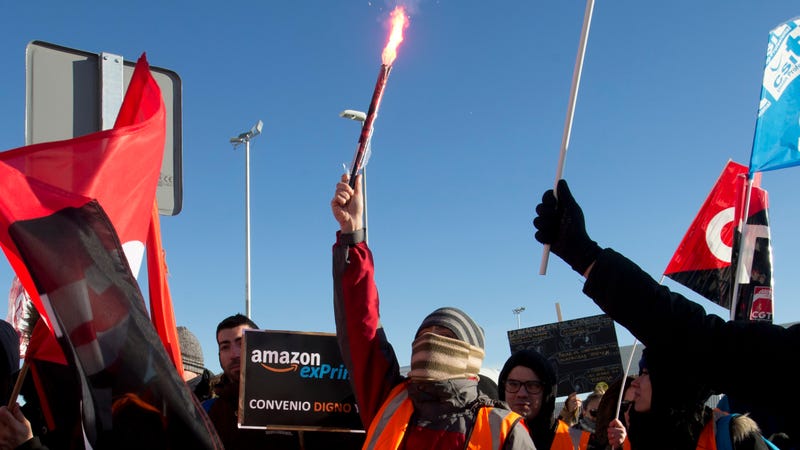
Despite this absurd level of resistance to our efforts, the tide began to turn during the spring of 2018. As the grovelling competition for HQ2 became more obviously pathetic, rebels in different cities began to catch on to the smell of bullshit. The first city outside of Seattle to initiate hostilities was Atlanta, and within a few months their efforts had garnered news-headlines, generalized disquiet, and channeled popular discontent against the Amazon leviathan. By then, major strike-waves had hit Amazon fulfillment centers in Europe, reminding us all that direct resistance was possible at the companies main logistic choke-points, its most vulnerable locations. There were a few instances of direct action and agitation around Seattle-area fulfillment centers, along with a few fruitless efforts toward infiltrating these places of work, but they largely went nowhere.
Amazon protest, Spain, March 2018
Outside of the mega-unions, there are few groups capable or willing to organize the Amazon fulfillment centers, a seemingly daunting task. While certain workers in Minnesota and New York have recently met with some success, there simply isn’t enough time to form militant worker’s organizations inside the fulfillment centers before they’re completely automated. At best, the IWW might create a few anti-capitalist locals strong enough to disrupt the shipping network, while the mega-unions might still be capable of raising wages for the last humans still employed in these warehouses. Regardless, the proverbial clock is now ticking upwards to midnight, and the future we’ve all dreaded is swiftly approaching. But we’ll get to that later, after the headlines.
Against the possibility of communism, against any possibility of happiness, there stands a hydra with two heads. On the public stage each one of them makes a show of being the sworn enemy of the other. On one side, there is the program for the fascistic restoration of unity, and on the other, there is the global power of the merchants of infrastructure—Google as much as Vinci, Amazon as much as Veolia. Those who believe that it’s one or the other will have them both. Because the great builders of infrastructure have the means for which the fascists only have the folkloric discourse.
-The Invisible Committee, Now, 2017
Opening The Curtain
After the May Day 2018 demonstrations had come and gone over the streets of Seattle, it was clear that Amazon was now seen as a public-enemy far outside anarchist circles. Anger against the HQ2 was rising from city to city, along with dozens of voices critiquing Amazon’s ruthless practices. In this moment, the leftists politicians of the Seattle City Council made their final stand against Lord Bezos and his greedy minions. Summoning every ounce of their spines, these elected officials passed a head-tax on the major corporations in the city, including Amazon, a law that would have generated revenue to build affordable housing for low-income and homeless residents. For a brief moment, it seemed like electoral-democracy had pulled a coup on us anarchists, proving that voting still mattered in the corrupt United States and affirming that leftists politicians could restrain the scrupulous tech-companies. Their hopes were quickly dashed.
All it took to cancel this tax was Amazon pausing construction on one of its HQ1 skyscrapers, a move that threw the conservative trade-unions into a frenzy. In an ill-fated photo-op, the socialist City Council-woman and her party held a protest rally outside the glass Bezos Balls, only to be met by a counter-rally of hard-hat wearing construction workers. This spectacle of socialists vs. workers was enough to explode the heavy contradictions in the air, dooming the taxation effort. Soon enough, the leftists in City Council withdrew from the battlefield, canceled the head-tax, and hung their heads in defeat. While some of the more pathetic Seattle liberals droned on about “damaging the anti-Trump resistance,” it became clear to many naive leftists that democracy didn’t stand a chance against Amazon. Although this hyper-local episode might not have registered amid the national static, its implications were felt deeply within the Democratic Party establishment.
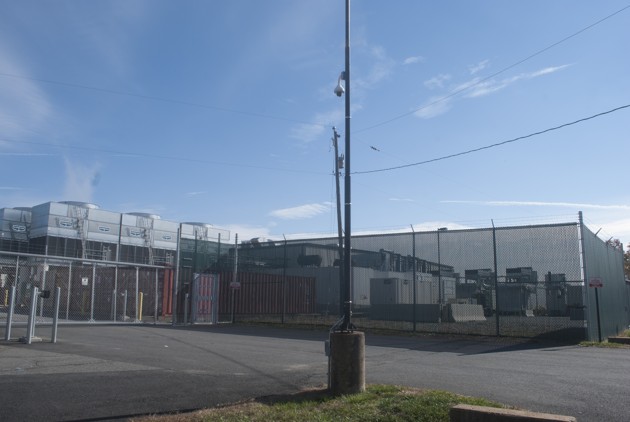
In November 2018, the long awaited results of the HQ2 contest were announced. Members of our editorial collective had privately predicted that Amazon would build its new facility near the CIA headquarters in Langley, Virginia, a logical move related solely to infrastructure. As one intrepid journalist from The Atlantic exposed, Amazon had already built a handful of anonymous data centers near spook-central, a site positioned in between where some of the main trans-Atlantic fiber-optic cables make landfall, allowing the CIA (and other agencies) to took scoop up massive amounts of internet traffic. By most accounts, Amazon Web Services account for at least 1/3 of all internet traffic in the US, while more recent estimates put this number closer to ½, if not higher.
Amazon data center near CIA HQ
Similarly, the location of HQ1 in Seattle was not chosen at random, it was selected for its proximity to a main fiber-optic node located below the twin-cylinders of the Westin Hotel, just a few blocks from HQ1. Long famous for gracing the cover of a Modest Mouse album, this hotel hosts one of the most important nodes of the internet and has long been a public secret across Seattle. According to a handy Wikileaks mapof Amazon facilities posted in 2018, a portion of this node belongs to the company under the name SEA4. Given all of this information, it was no surprise that Arlington, Virginia was chosen as the site of HQ2.
What did surprise us was Amazon announcing there were two lucky winners of the HQ2 contest. Not only would Arlington be graced with an economic atom-bomb, but Queens, New York would also be subjected to Amazon’s merciless gentrification and displacement. While cities like Atlanta breathed a sigh of relief, Queens braced itself for the impending invasion, although it didn’t throw in the towel and admit instant defeat (like Seattle). For the next months, radicals of various stripes began a campaign to block the HQ2 in Queens and prevent their community from being destroyed, an effort which made headlines across the US and inspired everyone who’d seen their own cities destroyed by the tech-leviathans. In the midst of these efforts, a scandal suddenly rocked Amazon and catapulted its deranged sultan into the media spotlight: Jeff Bezos had been cheating on his wife, Mackenzie Bezos.
Protest against Amazon HQ2, NY, 2019
While it might seem inconsequential, this affair had major implications. Firstly, it signaled that Jeff Bezos would soon lose the dubious distinction of being the richest man on Earth, given that Washington State divorce laws entitled his wife to half their fortune (making her the fourth richest woman on Earth). Secondly, Mackenzie Bezos had famously defended her husband when the book-length hit-piece The Everything Store: Jeff Bezos and the Age of Amazonwas published in 2013, an expose that unveiled the disgusting history of Jeff Bezos and Amazon. His loyal wife gave the book a one-star review on Amazon and claimed her husband was a good man in the review, an assertion she possibly came to regret. In January 2019, it was revealed that Jeff Bezos had been having an affair with Lauren Sanchez, a television host for the Fox network. Shortly before this revelation became public, Jeff and Mackenzie Bezos announced their divorce in a joint statement, hoping the scandalous affair wouldn’t reach the media, although the National Enquirer had different ideas.
This media-organ owned by a long-time friend of Donald Trump quickly published details of the affair, along with creepy texts from Lord Bezos where he referred to Lauren Sanchez as “alive girl.” In addition to leaking lurid selfies and partial dick-pics sent from the idiot man-child, the National Enquirer made Jeff Bezos the laughing-stock of the media and set off a political battle which included private detectives, Donald Trump, the Washington Post, and the Democratic Party. The liberal anti-Trump “resistance” tried to make Jeff Bezos into a victim of pro-Trump forces, an effort which was mildly successful, given the majority of the media coverage. Despite trying to pass himself off as the victim of right-wing blackmailing and extortion, King Bezos was still forced to read the writing on the wall and realize he was widely hated, along with his beloved Amazon.
While screen-shots of his imbecilic sexts were still circulating the internet, Amazon announced it was pulling out of the HQ2 deal in Queens. On February 14, 2018, the company stated on its blog that “a number of state and local politicians have made it clear that they oppose our presence and will not work with us to build the type of relationships that are required to go forward with the project.” Although the long and patient work required to scuttle this deal came from community organizations and radical groups, it was easier for Amazon to blame the politicians, thereby catapulting them to fame. Most notable among them was Alexandria Ocasio-Cortez (AOC), a Democratic Socialist and senator for the Democratic Party. As the organizers of the anti-Amazon campaign celebrated their victory, AOC was made into a spectacular villain or hero, depending on who you asked. In either case, responsibility for scuttling the deal was placed on her shoulders, not the people who made it happen.
For us editors, the victory in Queens was inspiring and joyful, especially after what we witnessed in Seattle. It was certainly gratifying to see the Democratic Party mayor of NYC and the Democratic Party governor of New York squirm like maggots when the deal fell through, but our joy was cut short when AOC willfully basked in the spotlight, thereby bolstering her electoral ideology and recuperating an autonomous anti-Amazon initiative that had taken almost two years to build. Ever since she famously championed her time as a bar-tender, it was clear that AOC existed solely to salvage the conception of fair-capitalism and instill her fellow millenials with the delusional hope that, if they only worked hard enough bar-tending, they could not only become a senator and “change the system,” they might even become an astronaut. In this regard, she represents the last chance for a dying Democratic Party establishment to reinvigorate capitalism and make it more youthful, hip, and able to tweet like a pro. Just because our opponents in the right-wing of capitalism despise someone like AOC, it doesn’t mean we should all support AOC and her left-wing of capitalism, especially when both sides want her to be the focus of everyone’s attention. Now that we’ve become sufficiently distracted from the issue at hand, it’s time to move on to the most disturbing part of this article.
Taking The Stage
From the extreme left to the extreme right, there’s no lack of bullshitters who endlessly promise us “a return to full employment”…It’s now necessary to be able to monitor en masse all our activities, all our communications, all our gestures, to place cameras and sensors everywhere, because wage-earning discipline no longer suffices for controlling the population. It’s only to a population totally under control that one can dream of offering a universal basic income.
-The Invisible Committee, Now, 2017
While the residents of Queens were able to stop the Amazon invasion, their peers in Arlington weren’t so lucky. Queens has long been a rebellious place and NYC still hosts thousands of radicals, as it has for over a century, making this region more resistant to blatant colonization. This wasn’t the case for Arlington, Virginia, a city that had the unfortunate reputation of hosting the Pentagon, which isn’t exactly a bastion of resistance. A coalition of local radicals organized to oppose this deal, but their efforts hardly stood a chance in this highly militarized hell-scape. Since the HQ2 deal was announced, housing costs in Arlington have risen close to 20%, while home vacancies dropped by nearly 50%, fulfilling all the predictions made by critics of HQ2. With the deal finalized, Amazon will soon move into a new luxury micro-city called National Landing, positioned just south of the Pentagon and across the river from Washington DC. Conveniently for Jeff Bezos, his new HQ is close to the Washington Post and within driving distance of his new DC home. From here, he can more easily masturbate to screenshots of Donald Trump’s tweets and stare longingly at the White House.
With the bald-headed scumbag now dreaming of becoming the president, his dick-pics still floating across the web, and his former wife having left him to his misery, Jeff Bezos has now gone into full-psychotic-overdrive. His first move after this series of disasters was to attend his very own MARS Conference in March 2019, a symposium dedicated to Machine Learning, Automation, Robotics, and Space. At this annual invite-only event, Jeff Bezos flew around in an octo-copter, played beer-pong with a robot, giggled at crop-pollinating drones, salivated to Lockheed Martin space-engines, and gazed in wonder at all the luxury gizmos he can afford to buy.
Bezos giggling at drone, MARS Conference, 2019
This MARS Conference has been held since 2016, and at each opening Jeff Bezos has done something cringe-worthy: in 2017, he piloted a massive robot and flexed it arms, while in 2018 he went on a stroll with a war-dog from Boston Dynamics. He was a bit more restrained in 2019, most likely from all the media attention, although this years attendees included Mark Hamill, famous for playing Luke Skywalker in the Star Wars films. He wouldn’t be the last Hollywood celebrity to suck up to Bezos in the coming months.
At this MARS conference, off-world-colonization was a major topic of discussion, given its little Jeff’s main obsession. His space company, Blue Origin, has successfully launched eleven of its reusable New Shepard rockets, paving the way for its first human crews. Over the years, Bezos has pumped billions of dollars into this space-colonization effort while ruthlessly exploiting his workers down here on Earth. As he makes plans to charge millionaires $300,000 for a few minutes in his spacecraft, his warehouse workers can barely afford to pay their rent. If you think this sounds horrible, keep reading.
Faced with mounting pressure from all sides, Bezos reluctantly agreed to pay his US fulfillment center workers $15 an hour in October 2018, although this seemed to piss off the tyrannical sociopath. Over the next months, he secretly accelerated his plans to fully automate the Amazon fulfillment centers by bringing more robots into the facilities. In a despicable yet typical move, Bezos instructed his underling to contact the media on April 30th, 2019 and announce that fully robotisized fulfillment centers were a decade away.
Able to breath easy knowing the public was placated, Jeff Bezos then went on to attend his very own invite-only event in Washington DC on May 9th, 2019, where he unveiled Blue Origin’s first lunar lander, signaling his intentions to use the moon as a stepping stone to colonize outer-space. As he described his colonial vision, Bezos said “you’re going to have whole industries. There are going to be thousands of future companies doing this work. A whole system of entrepreneurial activity, unleashed. Creative people coming up with new ideas about how to use space. Earth ends up zoned residential and light industry. It’ll be a beautiful place to live, it’ll be a beautiful place to visit, it’ll be a beautiful place to go to college, and do some light industry.” While admitting that the limitless growth and toxic pollution of capitalism are incompatible with a healthy planet, Bezos concluded that humans simply needed to extend that same limitless growth into space. As he asked the audience, “do we want stasis and rationing or do we want dynamism and growth? This is an easy choice. We know what we want.” While we obviously find this logic sickening, we clearly weren’t alone.
Mock-up of Amazon space-station, Blue Origin, 2019
Shortly after this disgusting conference in Washington DC, two anonymous Amazon corporate employees contacted Reuters and revealed Amazon’s secret plans to robotisize its fulfillment centers. According to these anonymous sources, Amazon has been installing boxing-machines that package commodities five time faster than a human. While the initial job losses in the US would be less than 2,000, the sources claimed that Amazon plans to vastly increase the number of robots. It’s unclear why these corporate employees leaked this information, but the announcement came less than two weeks after Amazon claimed full-automation was at least a decade away. In a panic, Amazon made a promise that same day to give $10,000 dollars to any of its warehouse employees who wanted to quit, but only if they pledged to start their own delivery company. With the leaked information now revealing that thousands would soon lose their jobs, Amazon had no choice but to dangle the promise of another job, this time delivering Amazon packages rather than sorting and boxing them. Instead of depending on the US Postal Service, UPS, or FedEX, the company now wants thousands of small contractors to hustle back and forth from the Amazon fulfillment centers.
As was stated in one of our previous critiques of Amazon, efforts to unionize these fulfillment centers are most likely doomed. By the time any organization forms a substantial block among the workforce, these facilities will no longer require humans. Unions in Europe have made the most advances in this regard and have staged numerous work-stoppages, although they’ve still been unable to achieve even moderate gains for their members. This leaves the delivery drivers as the final human workforce capable of sabotaging Amazon’s fulfillment network, but only if they’re organized under an anarchist union with the objective of destroying the company, not merely subsisting off its wages.
We don’t want to discount this possibility, but we also don’t want to impart any false hope. It would take a concerted effort to create an anarcho-communist union big enough to destroy Amazon and require months if not years to build the necessary membership. Amazon is a techno-fascist entity that needs to be taken down immediately, just as its overlord is a demented capitalist psycho-path who needs to be stopped, and its highly likely that unionism is not the way to accomplish these objectives. Amazon poses an existential threat to all free people on the Earth and plans to extend its ruler’s vision into space. To stop these techno-fascist schemes before they come to fruition, we need to act directly. Thanks to Amazon’s relentless expansion, its facilities are now everywhere, and as some anarchists stated decades ago, the secret is to really begin.
Burning The Stage
The revolutionary gesture no longer consists in a simple violent appropriation of this world; it divides into two. On the one hand, there are worlds to be made, forms of life made to grow apart from what reigns, including by salvaging what can be salvaged from the present state of things, and on the other, there is the imperative to attack, to simply destroy the world of capital.
-The Invisible Committee, Now, 2017
Without going into too much detail, we can confidently state that robotisization will create a level of unemployment unseen since the planetary recession of the 1920s-30s, only much bigger. We don’t know exactly what it will look like, but everyone seems to agree its effects will be massive and profound. Amazon is one of the main promoters of this shift, and its market dominance is now being challenged by governments in Europe and the US. While the European Council President Donald Tusk recently called Amazon and the tech giants “an uncontrolled, spontaneous empire,” his counterparts in the US are now moving to use an anti-trust investigation to break up the tech-giantsbefore popular anger grows to vast for them to control. Incidentally, the last time the US federal government broke apart big corporations was when the international anarchist movement was at its greatest strength.
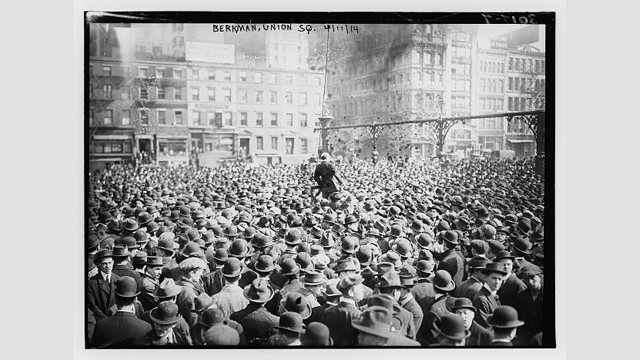
Alexander Berkman speaking against Rockefeller, NYC, 1914
When the US split apart Standard Oil in 1911, it was proceeded by an anti-trust investigation between 1904 and 1906, followed by a five year lawsuit. Popular anger against Standard Oil was at its peak, just as its CEO, JD Rockefeller, was widely despised across the US. This robber baron was forced to live in a gated compound, traveled only under heavy guard, and even his own family members began to kill themselves from the stress. Among the people leading the charge against the Rockefeller empire were the anarchists, a fact which spurred the federal government to intervene. If a similar anti-trust probe leads to a lawsuit against Amazon, it should be taken as a sign that we’ve entered another moment of strength. States only intervene in their free-market when its capitalists begin to destabilize the entire system through their recklessness. Rather than let a popular revolt grow beyond their control, the state will always usurp the rebels by claiming to be sole arbiter of justice. In the case of Standard Oil, all that happened in 1911 was that the company was broken into smaller pieces, most notably Chevron and Exxon. Petroleum didn’t stop belching from exhaust pipes, oil wells were still sunk across the land, and JD Rockefeller felt no hesitation in allowing the killing of his workers in the Ludlow Massacre of 1914. All the anti-trust lawsuit against Standard Oil accomplished was convincing the population that Rockefeller had been punished enough and helped diffuse popular anger. It did nothing to stop the expansion of Rockefeller’s empire, as should be evident from our pollution filled world today. We should expect nothing less from an anti-trust lawsuit against Amazon.
Despite all the popular anger and state pressure, Jeff Bezos doesn’t seem too worried. He just held another conference for himself at the Aria casino in Las Vegas called re:MARS and was able to show off the latest advances in robotic technology. An assortment of techno-fascists gathered to hear a variety of speakers, including Robert Downey Jr., star of the hit movie-series Iron Man. After playing a tech-obsessed CEO for Hollywood, this brain-damaged actor now claims he will start a company that will use robots to heal the damaged environment. As he told the star-struck audience, “between robotics and nanotechnology, we could probably clean up the planet significantly, if not entirely, within a decade.” At the time of this writing, Jeff Bezos is about to give a major speech to the attendees at re:MARS, but we won’t wait for this arch-swine to deliver more repulsive remarks. Now it’s time for resistance.
Bezos being rushed by animal rights protestor at MARS, June 6, 2019
Surprisingly or not, the most recent and effective actions against Amazon have emerged outside the US during the Gilets Jaunes (Yellow Vest) movement in France. Since the massive revolt kicked off in November 2018, multiple Amazon fulfillment centers have been blockadedby the yellow vest wearing rebels, with some warehouse workers even being fired for supporting the movement. Although some of these blockaders are part of the CGT trade-union, most of them are simply members of a diverse and widespread movement aimed against neo-liberal capitalism, the economic system which lets Amazon exploit workers across the globe. These blockades of Amazon facilities often take the company by surprise and happen mostly at night or early in the morning, with the most recent having occurred on May 30, 2019. There are twenty Amazon facilities in France with more than 7,000 employees, making it a much smaller workforce than the US. In other words, it’s much easier to paralyze, disrupt, or destroy. Since the movement began, the construction of a fulfillment center near Lyon has been stalled, while another near the ZAD of Notres-Dame-des-Landes has also been put on hold. While the battle is not over, if construction of these facilities proceeds, it will certainly ignite a serious conflict.
Gilets Jaunes blockade of Amazon, Montélimar, France, 2018
After seven months of Gilets Jaunes blockades, Amazon became the most hated foreign company in France, with even the besieged government being forced to respond. While consistently blacking out the existence of the Gilets Jaunes movement, the French state made much fanfare about a plan to tax Amazon and the other tech-giants. As was described above, this is simply a tactic to diffuse popular anger and prevent and all-out rebellion from destroying the company. Despite the hesitation of other EU states, France has now implemented its GAFA tax, forcing the tech giants to pay 3% (wow!) of what they make in the country. While this tax was passed in March 2019, it failed to stop popular anger against Amazon. Despite a government media-blackout being conducted against the Gilets Jaunes, the movement is still taking to the streets every Saturday, often with fiery results. It’s only a matter of time before we see an Amazon fulfillment center burning.
Gilets Jaunes blockade of Amazon, Bouc-Bel-Air, France, 2018
While we wish there was more resistance to Amazon in the US, we’re confident the rebellion will soon enter its second phase. The victory in Queens was the first time anyone was able to stop Amazon in its tracks, and the lessons learned along the way are still being digested. We wish everyone good luck in their future efforts and hope we’ve highlighted just how dangerous Amazon is. As was stated above, the secret is to really begin.



/cdn.vox-cdn.com/uploads/chorus_image/image/63053790/GettyImages_1091271442.0.jpg)



:format(webp)/cdn.vox-cdn.com/uploads/chorus_image/image/63962810/DSC04421.0.jpg)


