La Tarcoteca

La Tarcoteca

lunes, 12 de enero de 2015

Struggles and Victories of the IWA, 2014. Brief review

The past year saw the Sections of the IWA organizing more workplace struggles, more solidarity campaigns and more social protests than at any time since the decimation of the anarcho-syndicalist movement in the 1930s and 40s. We are not able to make a comprehensive account of all the actions but the IWA Secretariat would like to make a summary of international actions and local activities of the Sections.
International Solidarity Campaigns
The IWA supported a number of solidarity appeals this year, mostly to demand the reinstatement of dismissed workers. All such campaigns ended positively this year, with either the reinstatement of the comrades or agreements for monetary compensation.
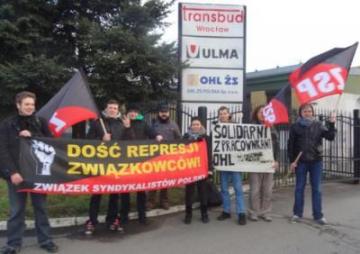
At the beginning of the year, we held solidarity actions for a comrade dismissed from OHL, one of the companies that cleans the streets of Madrid. Comrades in the east, where OHL is present (Poland, Slovakia and Russia) took part in the campaign. The conflict ended with an agreement between the company and dismissed employee.
At the beginning of March, solidarity actions took place in 13 countries against the practice of outsourcing at Santander Bank and for the reinstatement of the fired CNT delegate. The Sections organized actions in Poland, Argentina, Brazil, Germany, UK, Portugal, Norway and France and sent protests in other locations where there were no targets. Comrades from other countries like Uruguay and the US also took part. Another day of action took place in June – in total three days of action were organized in for this struggle. At the end, the company paid a settlement to the comrade, who had already moved to another city. The settlement was much higher than usual and the comrade believes it is because of the actions. To show his mutual aid, he and his union decided to send some of the money to other IWA comrades in struggle.
In March there were also solidarity actions for the freedom of the imprisoned oil workers of Las Heras , Argentina. Solidarity pickets took place at embassies in Belgrade, Warsaw and Oslo and a picket took place in Newcastle, where the comrades targetted HBSC for complicity. Later there were actions in Spain as well.
In April, several sections supported the case of a comrade from Spain against TNS , the international polling company. The comrade was fired after years in the company for trying to do something against the worsening conditions at the firm. ZSP, KRAS, NSF and ASI organized actions. In the end, the company recognized the illegal dismissal of the comrade and paid him a high compensation.
In May and June, a number of Sections send protest letters supporting workers from ZSP in Belchatow Hospital who were struggling to get their jobs back. The comrades in Slovakia also made a picket at the Polish Embassy. The workers were rehired after 3 months of occupation and action!
In June, some Sections made actions at Portinox/Teka company, to support the dismissal of the union delegate from CNT Granada. Solidarity came from Portugal, Poland, Norway and Slovakia. The comrade later was reinstated to his job!
In October, we took action against the firing of the union delegate from CNT Guadalajara from Truck and Wheel company, at the warehouse for BMW-Mini in Spain. Solidarity actions were made in Australia, Slovakia, Poland, Russia, Norway, Brazil and Germany. The comrade was reinstated to his job in the company!
Strikes
Dresden
The workers of the Trotzdem Bar in Dresden went on strike after some of them were fired. They interpreted this as anti-union activity. The workers set up protests outside the bar for many days. Although in the end they did not win, they fought for their dignity and set an example for many.
Belchatow
Workers from ZSP union at Belchatow Hospital won their jobs back after 3 months of struggle. Unfortunately, a few months later, the service provider who employed the workers started to lay off people, both in and outside the union, and increase the workloads of the others. At the beginning of November, the union decided to call an indefinite strike. Most of the other workers from this service company (cleaners and food servers) joined the strike, which was victorious after one day. In the end, more than 100 workers received normal work contracts with all benefits for the duration of the service contract.
Italy
Members of USI-AIT's various unions joined in the nationwide general strike on November 14. The main reasons for the proclamation of the strike were mostly against those laws the government is approving, in particular the Jobs Act, which is a anti-labour reform that will increase precarious work and will allow companies the utmost possibility to dismiss workers.
Pesués
At the end of May, the workers from CNT in Tinamenor factory went on strike to demand fixed employment. They had been on temporary contracts for many years, although this is not allowed and they should have already been given fixed contracts. The employer responded by firing the workers. The CNT has not stopped fighting and the conflict continues.
Barcelona
In February, the CNT in WFS airport services went on strike for two days. There have been ongoing struggles in this company over the last couple of years. The union is struggling for the reinstatement of three comrades.
Barcelona
On July 1, CNT participated in a taxi drivers' strike in Barcelona, against companies like UBER or BLABLA car.
Pilar de la Horadada
The CNT union in STV Management called a 24-hour strike in September. As far as we know, the workers' struggle is still going on.
Valencia
In the middle of December, CNT in Extracciones Levante called a three-day strike. The strike was motivated by some dismissals and the CNT would like a new collective agreement. We do not have any information of any results of the strike and assume the struggle in the workplace in pending.
Barcelona
The CNT participated in the strike of workers from Ambulancias Domingo , an ambulance company for three days at the end of December.
Madrid
The CNT also is taking part in the strike of garden workers from the Madrid Rio park. There is a plan to lay off 50% of the staff, so the workers went on strike. The strike is ongoing.
Other
We know that some CNT unions have participated in other strikes this year. Unfortunately we do not have enough information about this. There are lots of strikes in Spain and often the CNT takes part with the other unions.
ASI Education Union also took part in mass strikes in Serbia this December.

Workplace and Social Struggle around the Globe
It is difficult to get a grasp of all the workplace struggles the Sections have been involved in. Sometimes, our Sections work to provide solidarity to groups of workers, such as the Gestamp or Ceramicas Neuquen workers in Argentina. Other times, our unions take part in protest movements of workers from various unions, such as the protests of teachers and scientific workers in Moscow , which the KRAS Education and Technical workers union took part in, or protests of health care workers in Italy which members of USI-Sanita took part in. Any attempt to make a short list of struggles will inevitably leave some of them out. But a few worth noting.
In the UK, comrades from SolFed have had success this year with organizing workers and actions against wage theft.
Brighton
SolFed has been organizing workers through Brighton Hospitality Workers and has won a number of direct action campaigns, mostly against wage theft at restaurants and cafes in the city. It has had a long string of wins, mostly using pickets in front of the establishments.
South London, London
SolFed helped to organize a successful campaign to help a worker get money she was owed from Green Eco Plus. They also organized an action to defend a woman fired from a language school and, as a result, she received money and a positive recommendation.
Newcastle
Comrades helped a worker from North Tyneside receive a large settlement.
Slovakia, Australia
Comrades in Slovakia have started a Problems at Work campaign, to begin dealing with more workplace problems. They report good interest and have new contacts through the campaign. Comrades in Australia have initiated a similar campaign.
Social Struggles in Brazil
Our comrades in Brazil took part in major social protests in that country. In some cities they were among various groups organized but in other places they were the only organized force which could mobilize some people in the streets.
Berlin
Two members of FAU were among workers fired in the Swedish School in Berlin. Some protests and solidarity actions were held, but so far, there has been no progress towards reinstatement. There were also many demonstrations and pickets demanding pay for Mall of Berlinworkers who did not receive their salaries. This situation is still pending.
Montevideo
No, we don't have a section in Uruguay (yet) but some comrades and comrades from ASI helped stranded Serbian workers, who weren't paid and left without visas and tickets home.
Poland
Following dismissals in Dino supermarkets, ZSP started a campaign for reinstatement, for unpaid overtime and other improvements. The supermarket chain had to start making overtime payments and made payments for past overtime to different workers. Also several improvements to health and safety measures had to be made. The union is still fighting for reinstatement and has a discrimination case in the court.
Warsaw
The ZSP fought a number of struggles in this city. First, there was continued actions against Impuls work agency which brought tens of thousands of zloties in overdue pay to a number of their members. Then, in one language school, the school started to make all social security and benefit payments, which it hadn't made before. The union helped workers in one sex shop get money they were owed. Then it took action with a group of cooks and waiters from Doubletree by Hilton who hadn't been paid and the workers received their money very quickly afterwards. The union also started action at Citibank, where a comrade was fired for fighting against discrimination. There are now three lawsuits against the corporate giant. Finally, in support of the comrades from ZSP Amazon, there were pickets at Manpower and Adecco agencies which had to pay workers the remainders of their salaries which they had been shorted.
Spain
In Spain there are always lots of workplace conflicts and it is hard to make a list, much less say which are most important. Some were already mentioned under international solidarity campaigns.
A few others are:
Salamanca
Struggle of Arvato-Qualytel workers. They do customer service for Orange, work through the company Arvato-Qualytel, but without normal contracts. They are hired as temporary workers through Adecco and Randstad. They would like to be hired directly and receive proper benefits and have stable employment. 2 members of CNT were dismissed through non-renewal of contract and a confederal campaign has been going on. An international week of action will take place starting Jan.12
Madrid
The Education workers union is fighting against precarious working conditions in the University of Alcala. This includes fighting against the exploitation of fellows and doctoral teaching assistants.
Barcelona
The CNT won the reinstatement of a comrade dismissed from a EUREST cafeteria.
Spain
The CNT has managed to organize unions in several cities in Phone House. There have been numerous pickets organized around Spain, demanding better working conditions for the staff.
Another campaign which takes place in various cities is against Mercadona supermarkets. Earlier in the year, the supermarket had to pay half a million euros in compensation to fired workers. CNT continues to organize in the supermarkets and organize pickets around Spain.
Barcelona
The CNT managed to win the reinstatement of the comrade dismissed from SOS Childrens' Villages.
Vigo
The CNT won a settlement with Dominos Pizza who dismissed a member.

Repression and Solidarity
San Carlo
USI in San Carlo Hospital was repressed and ordered to pay a huge fine for supposedly insulting the bosses of the hospital. The IWA donated money to help.
Araxa
Comrades from COB in Araxa are being repressed. There were bogus criminal charges against one comrade, as well as charges of being in an „illegal union”. The case is ongoing.
Belgrade
In Serbia, the state is still trying to prosecute the Belgrade 6, whose case was appealed and re-opened after their aquital in 2010. The state is also trying to make a few fake criminal charges against other ASI members.
Warsaw
Several bosses have tried to make criminal cases and lawsuits against ZSP members for their syndical activity. So far the none of the criminal cases have stuck and the comrades have escaped punishment through the courts.
Operation Pandora
Several IWA Sections have already protested against repressions against anarchists in Spain. Comrades from France, Serbia, Portugal and Brazil have protested and denounced the repressions and of course the CNT has taken action across Spain.
Other
The IWA organized some presentations, workshops and training this year. The first was in Holland, where there was discussion of anarchosyndicalist organization and action. The next was in Hongkong and Taiwan, which saw many discussions and exchange with local activists.
Priama akcia also organized an international conference about organizing and internal matters in Bratislava.
Some Sections have been participating in a number of other campaigns. For example, in Lisbon and in Araxa, there are ongoing campaigns for free public transportation. In Warsaw, there is huge involvement in housing struggles. In Spain there are some collective projects such as the small farm Huerta de SOV Madrid. In Belgrade, ASI has been very active in student occupations and struggles.
We wish we could list all the struggles our Sections have been involved with, or events that they organized but this task cannot be realized by the IWA Secretariat this New Year's Eve. It is time to celebrate a successful year and to look forward to a new year filled with new struggles, new successes of our comrades and hopefully new comrades from around the world who want to work in solidarity. We wish all of our comrades from the IWA, from our Friends and comrades from non-affiliated organizations a Happy New Year and good luck to us all in the nearest future. We still hold a new world in our hearts.
Long live anarchosyndicalism and the IWA!
IWA Secretariat
Dec. 31, 2014

viernes, 9 de enero de 2015

The Asturian Commune of 1934


Today as yesterday Red Support will
take care of you families
The Workers’ Alliance sealed on 28th March 1934 was an agreement between the (anarcho-syndicalist) CNT and (socialist trade unionist) UGT, later joined by the PSOE (Socialist Party), the BOC (Worker-Peasant Bloc) and their youth organisations, the Communist Left and later the Communist Party. The Alliance intended to set up local revolutionary workers’ committees, each organisation retaining its independence, in a regional and eventual national alliance. This was to stand firm until a socialist federated society was achieved.
Such an alliance was only possible because of the supposed radicalisation of the socialists. Three years after the victory of the Left and the establishment of the Republic (1931) the Right had won the elections, and the PSOE and UGT began to talk about insurrection. They later admitted their rhetoric was the result of grassroots pressure. In Asturias he socialists were more revolutionary than elsewhere and the leadership closer to the people. This alliance would have been the key to success but in the rest of Spain there was no insurrection but a general strike.
The CNT in the whole of Spain was broadly in favour of an alliance but differed as to the timing. Many in the CNT, and also the FAI (Spanish Anarchist Federation), had doubts about its political implications, mistrusting the Socialists. But in Asturias, where 25-30,000 of the organised 80,000 workers belonged to the CNT (and sympathisers were put at a further 20 thousand) the other organisations combined were larger and (more importantly) not reformist as elsewhere. Even so, there were stormy arguments, not about the UGT but about the dubious role of the PSOE. The FAI would not join the Alliance, nor the La Felguera local Federation of the CNT. However, the FAI and the La FelgueraCNT threw themselves wholeheartedly into the insurrection.
The local Communist Party had a hundred out of only 800 members in the whole of Spain. It discredited the alliance, as it offered no scope for it to assume leadership. At the last moment it applied for membership, doubtless on instructions from the USSR.

Preparations for Red October

The Aliance CNT-UGT will erase fascism!
The anarchists of La Felguera had a resounding victory during the Duro-Felguera strike of 1933, and there were strikes and actions across Asturias. A general strike (8th December 1933) was called by the CNT across Spain, with sabotage, bombs and attacks on the security forces. Accion Popular (the right wing party of Gil Robles) tried to mount a rally from Covadonga (extolled by patriots as the town where the expulsion of the Moors began). The workers’ alliance (under the watchword UHP, Proletarian Brothers United) had called a strike throughout the mining region, leaving the streets, strewn with nails, with no taxis, rail connections cut, sporadic sniping and so on. Such actions led to the October 1934 rising.
On 4th October it was announced that three CEDA (clerical-fascist) members were joining the government and the Socialist Party in Madrid called at last for a general strike.

The events of the Revolution

Early on 5th October the Guardia Civil barracks throughout the villages of Asturias were called upon to surrender, and then attacked. When they had been overcome, revolutionary groups were set up in Sama, La Felguera and Mieres to attack Oviedo, the provincial capital, where there had only been risings in one or two barrios, and where the government forces had seized strategic positions. On the 8th/9th October the Model Prison in Oviedo was stormed and found to contain a huge quantity of rifles and machine guns but no ammunition. However, the government troops were forced to retreat.
On 9th October Gijon was bombarded by the Regular Army and Navy as were other towns. Gijon fell on 11th October. On 12th October the enemy seized back most of Oviedo and a new front was established. Without ammunition, the Provincial Committee was forced to surrender. General Lopez Ochoa, commanding, demanded surrender of the weapons of the captive Guardia Civil and Guardia de Asalto, restoration of all arms, the lives of prisoners taken to be spared, and the committees to give themselves up. No shots were to be fired on the advancing troops. The committees’ conditions for workers to lay down their arms were for the Tercio and Regulares to be kept out of the mining towns and withdrawn from the front on account of their bloody reputation.
Ochoa agreed to these terms, and the Committee surrendered on condition that none of the committee were handed over. The agreement was read out to the population in Sama, who greeted it with cries of “treachery”. They refused to surrender, knowing how vicious the repression would be. They said they would sooner take to the hills. In the end it was accepted as inevitable and when the troops entered the town there came the harshest repression yet known in Asturias.
Ever since March 1934 the people of Gijon had been demanding part of the weaponry seized from the towns but they were denied by the Socialists who had possession. Nor were they given any reinforcements once the revolt got underway. This delayed the insurrection there. In the end the industrial workers and fishermen in the town took to the streets, but the Yague Column (foreign legionnaires and Moorish troops brought in via Ceuta by sea) put men, women and children alike to the sword.

Army Atrocities

General Lopez Ochoa led 25,000 troops against Asturias, but the orders came from generals Franco and Goded in Madrid. Ironically (in view of what Covadonga was supposed to mean) they had brought Moorish soldiers back to Spain to wipe out the people. As the troops advanced they encountered blown-up bridges and roads blocked by trees, even where the revolution had not broken out, showing the depth of support it had. In Grado the armed forces faced resistance from a small group of 400 that forced them back to Aviles.
However when the troops reached Oviedo, the generals had all the wounded in hospital rounded up and shot. They did not even enquire which side they were on. The prisoners were questioned and shot. A hundred held out on Monte Naranco. In flushing them out, a young girl, 16 year old Aida de la Fuente was killed. Her friend was wounded and raped before being murdered.

Revolutionary Conduct

Three fronts of War:  
Battle front, Working front and Cultural front
All the Spanish historians, and even those who belittle the events, agree that in the anarcho-syndicalist areas like La Felguera, Ciano, Valdesoto and Gijon, there was greater respect and consideration shown to prisoners and clergy. During the struggle food was obtained by means of ration cards issued by the Supply Committee, determining allocation by family size. Foodstuffs were taken from warehouses and goods vans. All had access to them.
It is traditional for miners in Asturias to combine their toil with some gardening, so there was no shortage of milk and eggs in the hospitals. There are no large holdings there, only tiny holdings, so some way had to be found of obtaining meat without alienating the farmers. The committees bought in sheep from Extremadura shepherds, while in Pola de Laviana traders were paid for their foodstuffs. In these transactions, money (which had been abolished) was temporarily brought back. The Oviedo branch of the Bank of Spain was cleaned out.
Many fires were blamed on the “savagery of the miners” when in fact they were started by the military. In the case of the torching of the Campoamor Theatre in Oviedo, this was done by the revolutionaries, and had to be done to deprive the enemy of a vantage point. In this way, a nunnery had to be set on fire, though its residents were led to safety.

The committees

The War Committee attended to the distribution of materials and tactics. The Supply Committees allocated food and clothing to the villagers and fighters. There was also a Sanitary Committee, which managed the hospitals. In some cases medical supplies had to be manufactured: “staimant” splints for fractures were manufactured in Duro-Felguera. The Transport Committees in nearly every town had access to fifteen or twenty vehicles, while the Work Committees ensured the mines were kept in good order. Furnaces, which would be needed in a new society, were also kept in order. Telephone communications were restored or, where none had existed, introduced.

Repression

Once the rebels had surrendered, the police crackdown began. The signal was the ransacking of the Workers’ Athenaeum in Sama, with 500 books tossed on the flames.
The rubbish incinerator in Oviedo was burning for eight solid days burning bodies, including Aida and her female friend. By the end of October, 10 thousand people had been arrested, a third of them ending in prisons which had capacity for a couple of hundred.

Reasons For Failure

One might cite strategic oversights, the sectarianism of the Socialist leaders, lack of munitions, the deadly air raids, the failure of the Leon air base to rise in revolt, and of course the fact that in the rest of Spain, the rising held out for one or two days, at best amounting to a general strike and some sporadic shooting. But the fact is it could not have been otherwise.
The CNT and FAI, who enjoyed the sympathy of the Spanish workers, failed to throw themselves into the revolt in the rest of Spain because of the attitude of the PSOE, whose sole objective was to seize power and win back the support it lost among the workers due to its collaboration with the Primo de Rivera dictatorship (in which Socialist leaders like Largo Caballero had served) and its time-serving attitude under the Republic. The same might be said of the UGT.
In Catalonia the Generalitat declared an independent Catalan State. The Anarchists were alert and ready for a rising. But even as the new regional government was defying the national governments, anarchists were rounded up and jailed. The Generalitat’s council of defence declared “Watch out for the FAI”.
Anarcho-syndicalists could see the revolt there was nationalist and not revolutionary. Outside Catalonia the PSOEaimed only at a general strike, not a rising, a rebuke that was later put to it in Asturias. Anti-statist anarcho-syndicalism was not disposed to mount a rising that would simply be in the interests of a party and its trade union appendage. Only In Asturias did the proper conditions exist for the setting aside of past resentments and an insurrection in which all were united.
From: "CNT" (October 1993) Granada, reprinted in "Black Flag" 204, Spring 1994 . Translated by: Paul Sharkey.

lunes, 29 de diciembre de 2014

(VIDEO) Thousands of protesters claims fredoom for the seven imprisioned by Pandora Antianarchist Operation

The largest demonstration was held in Barcelona, but the protest was conducted simultaneously in ten cities of the Spanish State. Greater police presence harasses the concentration convened in Madrid.
PHOTO GALLERY
@FOTOMOVIMIENTO

Source- http://www.kaosenlared.net/component/k2/102860-v%C3%ADdeo-miles-de-manifestantes-reclaman-la-libertad-de-las-siete-personas-encarceladas-en-la-operaci%C3%B3n-pandora
_________
More tham 1500 protesters claim the Liberation of seven people imprisoned by Pandora Operation. Bcn
Jesus Rodriguez LaDirect

The more crowded march was the Barcelona one, but protest day was done simultaneously in a dozen cities in Spain.
Between 1,500 and 2,000 people attended the Saturday afternoon demonstration in Barcelona in a call from the Seven Imprisoned Support Assembly following the Pandora Operation. The march has started six quarters from Plaza Catalonia, followed closely by a dozen vans of Mobile Brigade (Brimo, antiriot hitmen). The police deployment, however, was minimal, as most of the Catalans Riot command are in holidays. The operational leader was a sergeants and not a sub-inspectors as usual, and was set only by two of eight Units based Sabadell. They was support by the ARRO unit ,  Barcelona pro-riots unit, who had been entrusted with the protection of Portal de l'Angel shopping center (own by "el Corte Inglés" fascist trust), the Justice Department and the CDC headquarters in Corsica Street.

Simultaneously held up to a dozen protests throughout Spain. In the center of Madrid a hundred protesters, 200 in Zaragoza and dozens Castellón, are some of the highest concentrations. Solidarity but also has internationalized and has shown today before the Spanish consulate in the capital of Slovenia and displayed in Lisbon tomorrow.

"Terrorist is who condemns us to a life of misery, not who rebelled against it," was the slogan that opened the event in Barcelona. Also shouting "The only terrorist is the Capitalist State" with the crowd went in and out of "El Corte Inglés" fascist shopping center and the ice rink that these days occupies the Catalonia Square. The journey of a mile walk along the Paseo de Gracia flow normally  with the fascist policemen vans at a distance. "Terrorism is not reached at the end of the month", "If touch one you touch us all" and "Ito ito, ito, the small bird to fall" in reference to the police helicopter hovering in progress at all the time and has inpirated some slogans more. The March reached Gran de Gracia. At this point where some protesters have broken with hammers crystals of banks, shops and a large hotel chains.

Banco Sabadell, La Caixa, Banco Santander, BBVA and Caixa Catalonia bank just ended with broken glass and some others multinational franchises apparel and a shop of gold and silver sales. The large windows of the "Hotel Casa Fuster" have been very damaged. It so happens that this building was the consulate of Nazi Germany in Barcelona in 1936, shortly before becoming the spring of 1937, the headquarters of the defense committee of the revolution driven by the CNT, FAI, the Libertarian Youth and the Iberian Communist Youth. Phalange took the building again in 1939. After the "Transition" period was the scene of a renewed dispute between the council and the local movement. The claim that there was both a social facility mitigated by the Catalan Socialist Party PSC, which chose to give the estate to Noga holding (based in Granada) license luxury hotel.

The sound of broken glass preceded a warning of "imminent charge" that the Mossos d'Esquadra issued by the speakers.

The sound of broken glass preceded a warning of "imminent load" that the Mossos d'Esquadra issued by the police van speakers. However, the MArch has reached Diamond Square and there has been called off, without oportunity to antiriot charge the bulk of the protest. Have been, however, some sliding between demonstrators and plainclothes agents. In one of these actions, Goya Street, a boy has been retained, has been identified and released.

To remember that Pandora operation, driven by the Mossos d'Esquadra Autonomic Catalan Police, unfolded the morning of December 16, fourteen searches of buildings ("Kasa de la  Mountanya", Libertarian Ateneo d'el Palomar, Poble Sec Anarchist Ateneo and eleven homes), eleven people arrested, seven of them imprisoned. Atorneis explained that some of them are dispersed and isolated under FIES penitentiary regime; they spend twenty hours a day completely isolated. Casta Judge Javier Gómez Bermúdez signed orders for admission to prison and, at the request of the Mossos d'Esquadra, agreed to the extend the secret summary of the investigation that began two years ago with multiple telephone interventions and monitoring.

As learned the direct drive of the Mossos d'Esquadra specializes in tracking the anarchist movement is still in force operating against the anarchist groups Coordinated (GAC), that supposedly would be the target of what the cabinet's press department Interior called "anarchist terrorism operation." Despite not being able to know the details of the case, through which the order was sent to prison seven anarchists learned that two of the signs would inculpatoris reading and distribution of the book "Against Democracy" and the use of the service encrypted e-mail server that offers Rise Up.

https://directa.cat/mes-de-1500-manifestants-reclamen-lalliberament-de-set-persones-empresonades-amb-loperacio-pandora
___________________
Democracy and the seven imprisioned anarchist. Mdr

The Spanish democracy not stops giving lessons. This morning of December 27 has been in Opera Square in Madrid, during concentration on solidarity with detainees by the under the eye judge Bermúdez before his so evident "anarchist terrorism".

Democracy that Goberment Delegate Cristina Cifuentes, and her well trained blue puppies understood as repression to anyone who disagrees with the postdictatioral regime. Massive identifications and an arrest, besides shoving and utter contempt for freedom. Meanwhile hundreds of pedestrians and citizens, those who will vote in their elections setting a good example in the "festival of democracy", spent long with purchases under his arm.

A concentration that almost has not even reached sixty minutes, with just one hundred attendees, but blue puppies well trained in rows with batons in their hands and helmets on belts, we assume that ready to democratize all the rebels that shout against this cruel, violent and chaotic system.

We have been filled with rage, because their violence is legitimized by law while our resistance causes the most horrible tortures. We have gone with the tension of having the most absolute trampling of human rights. But at the end of the day, we went with the joy of being accomplices of injustice.

Today in Opera, some deliver democracy, and the other fortitude, courage and solidarity.

Now, you should choose which side you're on.

Telecomunications and Computers Services Union (STSI)
[web]: informaticamadrid.cnt.es
[email]: informatica.madrid@cnt.es
[twitter]: @cntmadridinform
[facebook]: CNTinformaticaMadrid
__________


viernes, 21 de noviembre de 2014

Anarchism after the First International

Expulsion of anarchists and dissolution of the 1st Interancional
After the break up within the First International, years will come in which anarchism as a mass movement will suffer a setback. However, still many notable publications and libertarian activities. But anarchism should understand that can not fall back on any doctrinal idea, and should try to influence social movements in promoting self-management in all areas of the life.

As seen, Bakunin's anarchism had its importance in the First International, but the split between authoritarian and antiauthoritarian was inevitable. Will be a country where the libertarian spirit of the First International came to life in the so-called Spanish Republic Workers Federation; thousands of workers organized adopted the collectivist doctrine of Bakunin. Moreover, the anarchist communism of Kropotkin was becoming a noticeable trend widespread in other European countries such as France, Italy, Switzerland, Belgium and England 1.

Relationship between Anarchism and Socialism. The 2nd International
However, in the rest of Europe around 1880, anarchism seemed to regress and social democracy prevail, covered in industrial development and the achievement of certain political rights. The parliamentary reformism, obviously, renounced to the social revolution and merely aspired to take over the bourgeois state and promote certain claims immediately. Meanwhile, anarchism retreated in the rightness of their ideas in small groups organized covert action, not necessarily violent, although it is sometimes encouraged. While some consider that these actions aroused the proletariat revolt, for example in France, his state of stupor, others saw the violence away from anarchism to workers parlamentarist 2 disappointed with socialism. Anarchism was a substance of truly revolutionary socialist party, so its retreat to isolated facts, sometimes appreciable and other vulgar, perhaps it is because in those years could see how the masses adopted the easy way, accepting the leadership in organizations and canceling and all revolutionary impulse.

The rupture in the socialist movement became increasingly irreconcilable: anarchism seemed to fall in the late nineteenth century in the violent action, while supporters of parliamentary intervention pathetically lost their revolutionary condition. Whatever think about anarchist violence of those years, most of the cases reactions against the cruelty of the system, have to be very critical of those who thought that was the only way to initiate social revolt. Unfortunately, these events were exploited by bourgeois society to mislead the public that this was all anarchists knew to do. Sadly, as was said by the historian of anarchism Max Nettlau, was the situation of isolation, that could not last many years as will run parallel to the flowering of the rich libertarian corpus resulted in three economic concepts arises: collectivism, communism and mutualism.

However there may be mentioned, despite this general situation, some important movements that fuse anarchism with socialist currents: in the France region of Lyon a movement supported by Kropotkin (1881-1882); an anti-parliamentary socialism in England, then become an ally of the anarchist ideas of William Morris (1879-1894); in Austria, a revolutionary socialist, anarchist, that influenced even the heirs of the Social Democratic Party (1880-1884); in the United States, an anarchist collectivism examples of Johann Most and Albert Parsons (1881-1886), as well as the Chicago martyrs executed at the end of 1887, or the movement of international reorganization initiated by Malatesta in Italy 1883 and 18843. Were movments that had to be of interest to members of other socialist currents and bring them closer to anarchist ideas. Unfortunately, it did not happen, partly because of government persecution, which ended with the aforementioned movements, and partly because of the attitude of many anarchist militants had withdrawn to isolated facts and doctrinal rigor somewhat oblivious to what should be anarchism.

Strengthened by the situation, the Social Democrats met in Paris in 1889 to resume the conference and prepare the ground for a Second International. While some anarchists still want to participate, they soon arrived conflict and two years later, at a conference in Brussels, libertarians were expelled without further contemplation. In the held in Zurich in 1893, the Social Democrats shielded against anarchist intervention in proposing that, for the future and outside of unions, would just be admit parties and associations that accept only the parliamentary action.

Rise of Anarchism: propaganda by deed, unionism, free schools, direct action, self-management
Anarchism, by its eminently social nature, could not be permanently lost in those isolated facts or in the least dogmatic temptation. Kropotkin, who at that time become one of the main theoretis, made a fierce criticism to mere "propaganda by deed" and asked retrieve the associative spirit of the First International. To unlink the working class from socialist parliamentary influence must remain militant anarchism in social movements. So that begins to germinate what would be the unionist side of anarchism. A militant Fernand Pelloutier, in a text of 1895, links the trade union with the future libertarian society; a "practical school of anarchism" to cancell all political power and governed by self-management. It will be seen by some as a return to its workers roots of anarchism trying to bring the masses by revolutionary way to teach the primary libertarian idea of direct action 4.

Of course, not all anarchists saw with good eyes this confident in the trade union action. In the International Anarchist Congress in 1907, Malatesta enter into controversy with supporters of trade unionism to warn of the dangers of reformism, the bureaucracy and the conversion of some militants in "permanent staff" and "union employees". Both sides had their reasons, first it seemed essential that anarchism participate in the labor movement. On the other, it was inconceivable that the union be enough by itself to transform society.

Whatever the case, the incipient revolutionary syndicalism that was born at that time was directed more against bourgeois democracy, and against all influence of an alienated proletarian class, than against an anarchism, that was seen economicly favorable self-management producers. During the years before the First World War, the revolutionary syndicalist French movement led to the General Workers Confederation, had great power and can be seen as the synthesis between anarchism and syndicalism (as of 1914 it'll be something else). The mature fruit of this synthesis, however, will be the Spanish National Workers Confederation, founded in 1910.

Capi Vidal
Notes:
1.- La anarquía a través de los tiempos, Max Nettlau (Ediciones Júcar, Gijón 1977).
2- El anarquismo, Daniel Guerin (Proyección, Buenos Aires 1975).
3- La anarquía… op. cit.
4- El anarquismo… op. cit.

viernes, 24 de octubre de 2014

Mexican Anarchists Federation about Ayotzinapa School slaughtery: "bloody State Repression against students"

Mexico Anarchist Federation/Federación Anarquista de México

- To fellow students and teachers at Country Normal School "Raúl Isidro Burgos" Ayotzinapa, Guerrero: 
- To Relatives of the dead and kidnapped from the Country Normal School "Raúl Isidro Burgos" 
- To the people of Mexico: 
- Comrades: 

The bloody state repression against the Normal School Rural "Raúl Isidro Burgos" students in Ayotzinapa, Guerrero, 26th and 27th September 2014, murdered 6 companions, and 20 wounded 43 students missing. The killers were the Borought, State and Federal polices, supported by the Mexican Army. All three, Boruoght, State and Federal governments have conspired to carry out and cover up the infamous State crime. 
canalmatrix

Our hearts are sore, it hurts the deaths of our brothers. It hurts the absence and forced disappearance of our peers. We grieve the pain of the relatives, classmates and teachers from the Normal Rural Schoorl "Raúl Isidro Burgos" of Ayotzinapa, Guerrero. 

We are outraged and rebels against the pain, death and the forced disappearance of our Ayotzinapan brothers. 

Fellow Rural Normal School "Raúl Isidro Burgos" their pain is our pain, their rebellion is our rebellion. We embrace as embraces a brother in arms. 


Living were taken, alive we want them back! 

Anarchist Federation - Mexico, October 2014.

Source-Portal Oaca vía LA TARCOTECA Contrainfo: Anarquistas de México sobre la masacre de Ayotzinapa: "sanguinaria represión estatal contra los estudiantes"

Spain Antimonarchical Call: Dignity Marchs to Oviedo 23th, 24th October against Real Larceny

We Unemployed, WE ARE REAL, we evicted WE ARE REAL, women who abort WE ARE REAL, we homelessness WE ARE REAL, precarious WE ARE REAL, patientes, WE ARE REAL, students ARE REAL, pensionist WE ARE REAL... Our RIGHTS and FREEDOMS ARE REALS.

And what is an UNREAL DECEPTION is the political and economic Power meeting at the Campoamor Theatre on 24th October under the umbrella of the successor of Franco monarchy to surrender him homage while holding, pushing and enriched with Neoliberal policies. Impoverish, repress us and kidnaping concepts such as DEMOCRACY.

Rally bigger each year. No place to hide for white collar villians.

WE DO NOT WANT TO LIVE UNDER THE ILOGIC OF GREAT CAPITAL INHUMAN EXPLOITATION! 
24th October 2014, 17:00 H,  meeting as close to the Campoamor Theatre as we could, the place where meets the crap that lead all us to  misery. 

We want to BOOST THE SOCIAL CHANGE based on social justice and redistribution of wealth! 

WE ARE REAL Campaing aims to promote and contribute the 24th October mobilization  overflow the frame itself of the mere protest, surrounding and ridiculing the stale and elitist "dandruff caste" entrenched in Campoamor Theatre.

NO TO UNEMPLOYMENT, NO TO DEBT, BASIC WAGE AND PUBLIC SERVICES! WE KEEP ON BOOSTING THE SOCIAL CHANGE!

Dignity Marchs have called which is expected to be a mass mobilization in Oviedo next October 24 to coincide with the delivery of the Prince of Asturias awards. Collective from las Cuencas, Siero, Gijon, Avilés and Grado converge in the Capital of the Principade to public protest and visible around the Teatro Campoamor.

The concentration is part of the campaign We are Real driven by the 22M Marches Dignity Assemblies. The organizers, who officially presented on Wednesday the initiative, and have the support of groups from other regions who have confirmed their presence in Asturias on the day of delivery of the Prince awards.

We are Reales is not only reduced to a protest on the day of the award ceremony. During the previous week, the organization plans to develop various debates on the issues, in his opinion, most concerned citizens.

The collective 22M recalls that during recent years, has done a protest rally in the Square Escandalera in Oviedo coinciding with the ceremony of the Prince of Asturias Awards.
 "We protest against the cuts, layoffs, business closures, evictions ... and against waste and institutional farce that involves organizing the gala as a mechanism for legitimization of the monarchy," say the organizers. 
With the launch of the campaign We Are Real marches dignity join this protest and seek to promote a "mass mobilization and discussion of great social significance" to make visible the "real problems of social majority, its consequences and possible solutions. "

The assembly of the Dignity Marchs highlight that brings together representatives of the economic and political powers "that promote or support the neoliberal measures that have ended up impoverishing the population" in the ceremony of awards. Unemployment, precariousness, evictions, deprivation and cuts to public services such as education and health, the reduction of freedoms, racism, gender inequality, illegitimate debt, social injustice ... are just some of the problems denouncing the collective.
"The powers that have driven these neoliberal policies coalesce under the umbrella of the '78 monarchical regime. They do -continúan Saying convocantes- "to legitimize all together before the people, so they used to reward social tagging personalities far from their real social elite and opulence objectives." 
WE ARE REAL Planning

Asturias begin on 20th actions and Forum conversations by locations.

Day 23 Afternoon receive you come to other territories. 
18:00: Social Forum OUR RIGHTS ARE REAL
20:30: Roundtable: POWER TO THE MOST
22:00 Dinner OUR HUNGER IS REAL
23:00: Presentation: Principe of Cast Affair counter Awards
Day 24 Early in the morning breakfast and depart of columns walking towards Oviedo (about 17 miles per column) where we arrive at lunch. The columns will come from Avilés, Gijón, Mieres, Oviedo, Pola Siero ...
14:30 Reception of the columns in the Paseo de los Alamos, Oviedo
14:30 Lunch OUR HUNGER IS REAL in Oviedo (if weather permits in the San Francisco park)
17:00 H. Rally as close as we can to the Campoamor Theatre, where meets all the bastards that are leading us to misery. 
21:30 H: Cena OUR HUNGER IS REAL 
22:00: Concert "Our Dignity is Real": Gente del Pueblo, Dixebra. 
  Day 25 Breakfast and return to the territories. 

Bring sleeping bags.

Will set lodges and companions houses for those who can not sleep in sport centers but please report it previusly pto know where to place each one.

Nos vamos a Asturias – Las Marchas de la Dignidad convocan una movilización masiva el día de los premios Príncipe | Marchas de la DIGNIDAD 22M

domingo, 5 de octubre de 2014

The anti-fascist collective Algarada review victory against neo-Nazi center in Madrid

After a month and three days of fighting for a whole neighborhood, Tetouan distric reach to generate social pressure that permit expel out the neo-Nazi group who had occupied a building in the heart of the neighborhood known as "the Social Home". Must be clear that without the peoples pressure, that xenophobic group linked to far-right parties, would still be there. We believe that was a victory against fascism and racism.

Said that, from Algarada ["Popular  Riot" antifascist group] want to notice that we are proud of what happened during this month of Solidarity between Tetouan neighbors [Barrio de Tetuán] and other districts of Madrid, and the anti-fascist and anti-racist struggle that has developed. But, as antifascists, we can not stake there and boast after this, we must continue to fight every day against these violent and racist elements that have no place in our neighborhoods, and those who continue to fight every day as we were doing before. Fascism, racism and Nazism, are still there and are a great danger if we do not fight to their end.

Without organization, to reject these Nazi-fascist elements of our neighborhood would have been much more difficult, if not impossible, so we consider essential for every neighborhood to set an Coordination, in case of fact as in Teotouan happen again, to give a overwelhim, quick and organized response, cutting short the problem.

Therefore, we say and state loud and clear:

RACIST OUT OF OUR NEIGHBORHOODS 
TETUÁN ANTIFASCIST

Source- Algarada via LaHaine.org

Spanish version- LA TARCOTECA Contrainfo: El colectivo antifascista Algarada, de Tetuán, valora la victoria contra el centro neonazi. Victoria!

viernes, 3 de octubre de 2014

Canary Anarchist Federation, Victoria!: "Only by Mutual Support People can get what they need"

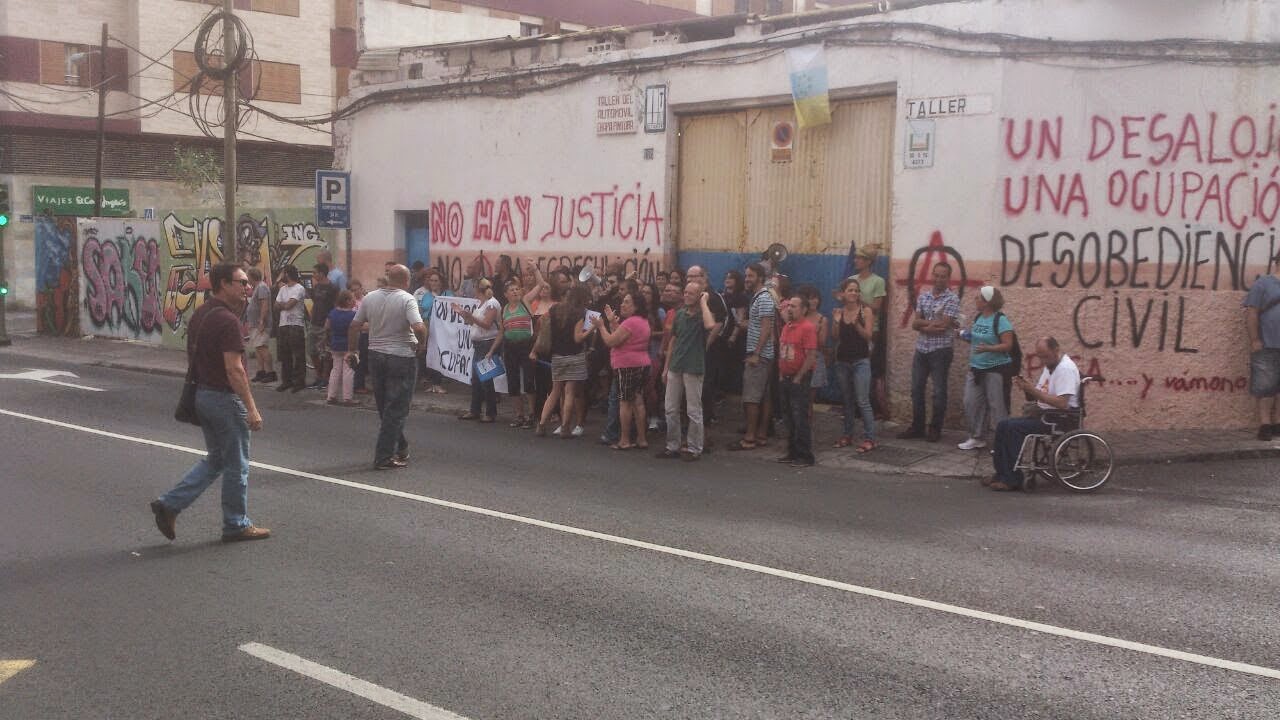
anti-evictions picket Members last Friday managed to prevent
 an eviction in the grancanario neighborhood Guanarteme
"Evictions can be stop when there is a real intention to do it. Only mutual support and direct action, not promises made by parties in campaign, enable the people to get what we need." 
This is one of the conclusions, as the Gran Canaria Anarchist Federation FAGC, Spain, that can be extracted from the action taken by a anti-evictions picket last Friday. Could postpone the eviction of a father and his son-Ignacio and Manuel - from their home -workshop in the popular neighborhood of Gran Canaria, Guanarteme.
"The Federation - explain libertarians - was calling  calling to picket for a week to prevent eviction, and dozens of neighbors and residents of the"La Esperanza Community"rode in several vehicles, a lot of miles to move up Guanarteme where was scheduled to happend"
"When we got to the place - continue to expose - the assembled forces were few. A majority were comrades from La Tomatera [Social Centre] and a minority of the 15-M Guanarteme Assembly [occupy] and the the Unemployed Assembly, while the rest were relatives of the affected, independent activists and some neighbors and curious."
Anarchists stand, finally, half of those gathered on the picket line were members of that community "La Esperanza", formed by a group of needy families, in February 2013, they were relocated by the Federation in a few blocks abandoned have been enabled to make in your home. 
A particular circumstance considered "creditable", because it is people who, in most cases, participating for the first time in one of these pickets.
"We highlight that people with no other ideology but mutual support went to confront abuse with no more goal than to do the right thing and prevent a family lost their home as had happened to them, since most of the residents of the Community have been evicted in the past. "
"THE ARRIVAL OF ACRATS FELLOWS WITH MORE EXPERIENCE FORTIFIED POSITIONS" 

The Anarchist Federation points out, however, that the arrival of anarchists comrades with more experienced stopping evictions fortified the stand.
"They recommended closing the doors of the workshop as soon as possible and rally on the sidewalk where the property was located, deploy between the two possible entries, giving strategic and legal advice in case of detention, etc. The idea was to build a wall of meat that prevented police and judicial intervention. "
"At the time, -explican -. Appeared judicial commission that was soon repelled by the gathered. After this skirmish, which showed the police that his speech was inadvisable, the picket stood firm, without the fake withdrawal of Local Police and the commission offered us no reason to trust. One of the factors that made us remain vigilant was the presence of three secret police (the Information brigade) easily identified by their inexperience and low capacity to spot."
"Past the hour, according to the closure of the courts approached - added - became clear that the eviction was going to be postponed (later learned that this is not a victory, it is only a truce). Time for Banca March acept to negotiate with Ignacio, if such entity does not want its public image deteriorate and have to undertake a second round even more tough and bitter. "
"THE POSTPONEMENT OF EVICTION REASSERT THE OLD ANALYSIS: MUTUAL SUPPORT WORKS"
Anyway, the Anarchist Federation also appreciates that the postponement of the eviction has ratified old analisys and allow to start new ones". "And not just us  but also to those involved in an action like this for the first time." For libertarians, these people could understand, in practice, that "by many political readings that attempt to do an eviction and by much desire for prominence there among some, anti-eviction picket must have, it seems obvious, a main goal: affected keeps home." [opposite to some antieviction pickets that just look for publicity with political purposes]
   Similarly - added - "have learn:
- That as important as the number of attendants picketing is the attitude and strategy;
- That the collective that monopolize press attention participation in front of the house [looking for publicity], such as PAH, can quietly refrain from intervening in such pickets even though the evicter is a bank and not an individual;
- That will to stop an eviction outweighs any other consideration, and
- Sometimes, although not desirable, more than twenty people from the other end of the island can supply the low participation of the neighbors in the neighborhood. "
   "Making a particular reading -holds- this eviction has also allowed many relocated in the Community" La Esperanza "be aware of their potential and that only direct Action and Mutual support, not campaign promises of the parties and their white brands [new political citizen parties], enable the people to get what they need. "
    "We wish- conclude - that this month Ignacio could negotiate in their favor and impose its demands. If not, we will come back to Guanarteme. More and stronger...". 
By EUGENIO FERNANDEZ 
Victoria!
Source- "Solo con el Apoyo Mutuo el pueblo puede obtener lo que necesita"- Canarias-semanal.org vía Tarcoteca contrainfo
https://www.youtube.com/channel/UCWDr0D7LGumWEhw9WL6Ofew
Comunidad La Esperanza - YouTube

For more information:
Anarchist Federation Gran Canaria: The Anarchist Federation GC already resettled over 70 people: 
Federación Anarquistas Gran Canaria: La Federación Anarquista de G.C. ya ha realojado a más de 70 personas
[YES WE CAN] The Gran Canaria Anarchist Federation and La Esperanza Community achieve to postpone a eviction: [SI SE PUEDE] La Federación Anarquista de Gran Canaria y comunidad La Esperanza logran aplazar un desahucio